

10 Real-World Human Intervention Automation Use Cases
Automation is often sold as a way to eliminate manual work. Connect your apps, build a workflow, and let software handle the process from start to finish. While that sounds appealing, it doesn't accurately reflect how most businesses operate.
Consider something as simple as approving an invoice. A company may receive hundreds of invoices every month, and much of the work involved in processing them is repetitive. Invoice details need to be extracted, vendor information needs to be verified, purchase orders need to be matched, and records need to be updated in accounting systems. All of these tasks are perfect candidates for automation.
But should the final payment always be approved automatically?
Most finance teams would say no.
The same pattern exists across almost every department in an organization. A sales representative may request a larger-than-usual discount to close an important deal. A customer may ask for a refund that technically falls outside company policy. A marketing team may use AI to generate content but still want an editor to review it before publication. An employee may request access to a sensitive system that requires managerial approval.
In each of these situations, the workflow itself is straightforward. The challenge is not moving data between applications or triggering actions. The challenge is making a decision.
This is where human intervention becomes an important part of workflow automation.
Rather than attempting to automate every decision, businesses often automate everything around the decision. The workflow gathers information, performs calculations, updates systems, and prepares the next action. When it reaches a point where judgment is required, it pauses and asks a person what should happen next. Once the decision is made, the workflow continues automatically.
In practice, this approach often produces better results than trying to fully automate every process. It allows organizations to benefit from speed and efficiency without giving up control over important business decisions.
Why Businesses Need Human Intervention in Automated Workflows
One of the biggest misconceptions about automation is that every manual step is a problem that needs to be removed. In reality, some manual steps exist for very good reasons.
Imagine a company that automatically approves every expense claim submitted by employees. At first glance, this sounds efficient. Nobody has to review receipts, managers don't need to spend time approving requests, and reimbursements can be processed instantly.
Now imagine an employee accidentally submits an expense for ₹1,50,000 instead of ₹15,000. Or submits a personal purchase as a business expense. Or uploads the wrong receipt altogether.
The workflow has no understanding of context. It only knows how to follow rules.
Even if sophisticated validation checks are added, there will always be situations that require human judgment. Was this purchase necessary for a client meeting? Is an exception justified because of a special project? Does this expense comply with company policy?
These are business decisions, not technical decisions.
The same principle applies to many automated processes. A workflow can identify that a customer has requested a refund, but it may not understand the nuances of the customer relationship. A workflow can calculate a discount, but it may not know the strategic importance of winning a particular deal. A workflow can generate content, but it cannot always determine whether that content accurately represents a brand's voice and expertise.
Businesses don't add intervention steps because automation is incapable. They add them because certain decisions carry financial, legal, operational, or reputational consequences.
The goal is not to remove people from the process entirely. The goal is to involve people only when their expertise adds value.
How Human Intervention Works Inside a Workflow
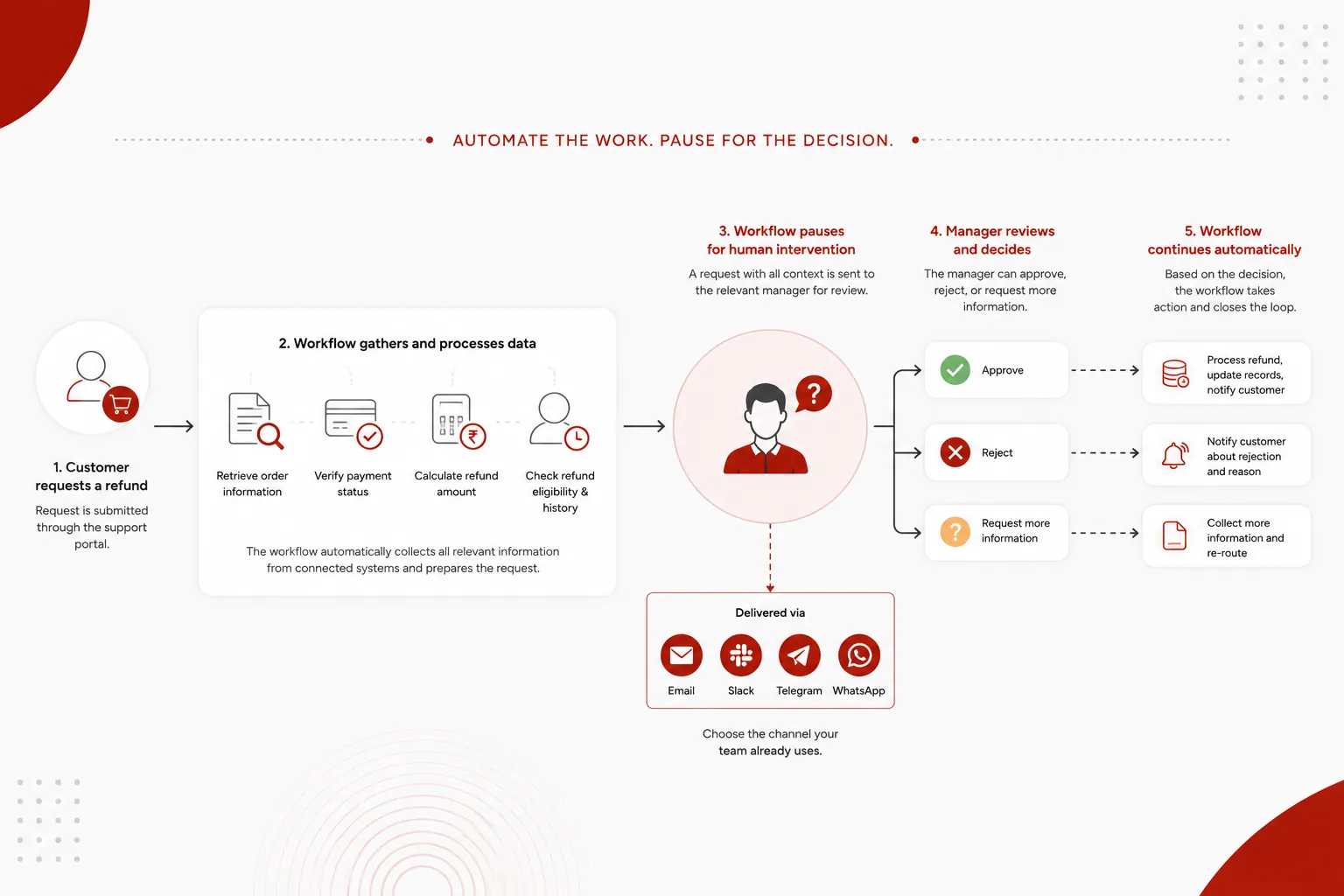
To understand where intervention fits, let's look at a practical example.
Suppose a customer submits a request for a refund through a support portal. Without automation, a support representative would typically gather information from multiple systems before making a recommendation. They would look up the order, verify the payment, check the customer's purchase history, review previous refund requests, and confirm whether the request falls within policy guidelines.
Most of this work is repetitive.
A workflow can perform these tasks automatically within seconds. It can retrieve the order information, calculate the eligible refund amount, verify payment status, and collect relevant customer data from multiple applications. By the time the workflow finishes, all the information needed to make a decision is already available.
At this point, instead of automatically issuing the refund, the workflow pauses.
A support manager receives a message containing all relevant information and is asked a simple question: should the refund be approved?
The manager reviews the information and responds.
If the answer is yes, the workflow processes the refund, updates the customer record, sends a confirmation email, and closes the ticket automatically. If the answer is no, the workflow notifies the customer and records the reason for rejection.
Notice what happened here.
The workflow handled all of the repetitive work. The manager contributed only the one thing automation could not reliably provide: judgment.
This is what makes intervention-based workflows so effective. Humans are no longer responsible for administrative work, data gathering, or system updates. They are only responsible for making decisions.
Everything before and after that decision remains automated.
Real-World Use Cases for Human Intervention in Workflow Automation
Human intervention can be added to almost any workflow, but it is particularly valuable when decisions have meaningful business impact. Let's look at some of the most common examples.
Invoice Approval and Payment Processing
Finance teams spend a significant amount of time processing invoices. A typical invoice often passes through multiple stages before payment is released. Details need to be verified, vendor information needs to be checked, purchase orders need to be matched, and approvals need to be obtained.
Without automation, much of this process happens through emails, spreadsheets, and manual follow-ups. Finance teams frequently spend more time coordinating approvals than actually reviewing invoices.
A workflow can automate the majority of these tasks. When a new invoice arrives, the workflow can extract information from the document, validate vendor details, compare it against purchase orders, calculate totals, and identify the appropriate approver.
The final approval remains with a finance manager or department head.
Once approved, payment processing, accounting updates, record keeping, and notifications can happen automatically. Instead of reviewing every piece of information manually, approvers only need to focus on the decision itself.
This reduces administrative overhead while maintaining financial controls.
Sales Discount Approvals
Sales teams often need flexibility during negotiations. A discount that seems aggressive on paper may be justified if it helps secure a high-value customer or unlocks a strategic opportunity.
At the same time, companies cannot allow unlimited discounts without oversight.
A workflow can automatically calculate discount percentages, projected revenue impact, profit margins, and deal value. Rather than asking managers to collect information from multiple systems, everything is prepared and presented automatically.
The manager simply reviews the request and decides whether the discount should be approved.
Once a decision is made, the workflow updates the CRM, notifies the sales representative, and continues the sales process automatically.
The organization maintains pricing control without slowing down sales operations.
Customer Refund Requests
Customer refunds are rarely as straightforward as they appear. While some refund requests clearly qualify under company policy, many fall into a grey area where context matters as much as the rules themselves.
Consider a customer who is requesting a refund after the official refund period has expired. A fully automated system would likely reject the request immediately because it does not meet the predefined criteria. However, a support manager reviewing the same request might notice that the customer has been purchasing from the company for several years, has never requested a refund before, and recently experienced a legitimate issue with the product.
The decision is no longer just about policy. It is about customer relationships, retention, and long-term value.
A workflow can handle the operational side of this process automatically. It can retrieve order details, verify payment status, calculate the refund amount, check previous refund history, identify customer lifetime value, and gather any relevant support conversations. By the time the request reaches a manager, all of the information required to make an informed decision is already available.
The manager does not need to spend time searching through multiple systems. They simply review the situation and decide whether the refund should proceed. Once a decision is made, the workflow automatically handles payment processing, updates customer records, notifies the customer, and closes the support ticket.
This approach helps businesses maintain consistency while still allowing flexibility when exceptional situations arise.
Content Review and Publishing
The rise of AI has dramatically changed how marketing teams create content. Blog posts, social media updates, email campaigns, product descriptions, and landing page copy can now be generated in minutes rather than hours.
However, generating content and publishing content are two very different things.
Even the most advanced AI systems can make mistakes. Facts may be inaccurate, examples may be outdated, brand guidelines may be overlooked, or messaging may fail to align with business goals. Publishing content without review can lead to errors that damage credibility and create unnecessary risks.
This is why content review remains one of the most common intervention points in modern marketing workflows.
A workflow can automatically generate content, perform SEO checks, gather supporting data, and prepare drafts for publication. Instead of requiring marketers to manually move content between systems, the workflow can present the completed draft directly to an editor or content manager.
The editor's role is no longer administrative. They are not formatting documents or copying content between tools. Their responsibility is simply to review the output and determine whether it meets quality standards.
Once approved, the workflow can publish the content automatically, distribute it across channels, update content calendars, and notify relevant teams.
This creates a balance between speed and quality. Teams benefit from automation without sacrificing editorial oversight.
Vendor Onboarding and Procurement Reviews
Adding a new vendor often involves much more than collecting contact information. Procurement teams may need to review contracts, verify compliance documents, evaluate pricing agreements, assess security requirements, and ensure that vendors meet internal policies.
Without automation, this process frequently involves long email chains, multiple spreadsheets, and repeated requests for missing information.
A workflow can simplify much of this work. Vendor applications can be submitted through forms, supporting documents can be collected automatically, compliance checks can be initiated, and required information can be validated before anyone becomes involved.
Once all documentation has been gathered, the workflow can route the application to procurement managers for review.
At this stage, the manager is not chasing paperwork or requesting missing documents. They are evaluating whether the vendor should be approved.
If approved, the workflow can automatically create vendor records, update procurement systems, notify finance teams, and trigger onboarding activities. If additional information is required, the workflow can request it automatically and continue once the missing details are received.
The procurement team remains responsible for decisions, while automation handles coordination and execution.
Employee Access Requests
Security is one of the clearest examples of where human judgment remains important. Employees frequently need access to applications, databases, internal systems, and business tools in order to perform their jobs. While granting access may seem like a routine task, giving someone the wrong level of access can create serious security and compliance risks.
Imagine a new employee requesting access to customer databases, financial records, or production systems. Automatically approving every request would save time, but it would also remove an important layer of oversight.
A workflow can collect the access request, verify the employee's role, identify the systems being requested, and determine who is responsible for approving access. The relevant manager then receives a request containing all necessary information.
Instead of manually creating tickets and coordinating approvals through email, the manager simply decides whether the access should be granted.
Once approved, the workflow can automatically provision access, update permissions, notify the employee, and record the action for auditing purposes.
The result is a faster access management process that still maintains strong security controls.
Recruitment and Hiring Decisions
Hiring is another area where automation can significantly improve efficiency without replacing human judgment.
Recruitment teams often spend considerable time screening resumes, scheduling interviews, collecting feedback, updating applicant tracking systems, and coordinating communication between stakeholders. Much of this work follows predictable processes and can be automated effectively.
A workflow can automatically collect applications, evaluate predefined criteria, schedule interviews, send reminders, gather interviewer feedback, and maintain candidate records.
However, selecting the right candidate is rarely something that can be reduced to a simple set of rules.
A candidate may not have the strongest resume but may demonstrate exceptional communication skills during interviews. Another candidate may have impressive qualifications but may not align with team culture or role expectations.
These decisions require experience, judgment, and human insight.
By automating administrative tasks while preserving human involvement in hiring decisions, organizations can accelerate recruitment without sacrificing candidate quality.
Procurement Requests and Purchase Approvals
Every company purchases software, equipment, services, and operational resources. While many purchases are routine, others involve significant spending and require oversight.
A workflow can automatically capture purchase requests, calculate budgets, validate spending limits, identify department ownership, and gather supporting information.
Instead of managers reviewing incomplete requests and asking for additional context, they receive a complete summary containing everything they need to make a decision.
For example, if a team requests a new software subscription, the workflow can provide pricing information, current budget allocation, existing software licenses, and business justification. The manager's role is reduced to evaluating whether the purchase makes sense.
Once approved, the workflow can generate purchase orders, notify vendors, update procurement systems, and inform finance teams automatically.
This reduces approval delays while maintaining spending controls.
Contract Reviews and Legal Approvals
Contracts often move through multiple departments before they are finalized. Sales teams, procurement teams, finance departments, and legal teams may all need to review different aspects of the agreement.
Without automation, contract reviews frequently become bottlenecks. Documents are shared through email, feedback is scattered across conversations, and stakeholders struggle to track progress.
A workflow can centralize the entire process. Contracts can be collected automatically, stakeholders can be notified, review stages can be tracked, and reminders can be sent when approvals are delayed.
The legal team is still responsible for evaluating terms, obligations, and risks, but they no longer need to manage the administrative process surrounding the review.
Once the contract receives final approval, the workflow can route it for signature, store the finalized agreement, update CRM records, and notify all stakeholders automatically.
This creates a more efficient contract lifecycle while preserving legal oversight.
AI-Generated Content Validation
As AI becomes increasingly integrated into business processes, one of the most important intervention use cases is validating AI-generated outputs before they are acted upon.
AI can draft articles, generate customer responses, summarize documents, classify tickets, extract information, and perform many other tasks at remarkable speed. However, speed does not guarantee accuracy.
An AI-generated customer response may contain incorrect information. A generated report may misinterpret data. An automatically created blog post may include outdated facts. Even when AI performs well, organizations often need accountability before important information is published or shared externally.
A workflow can use AI to generate content, recommendations, summaries, or decisions and then route those outputs to a human reviewer.
The reviewer examines the result, makes any necessary changes, and approves it for use. Once approved, the workflow continues automatically.
This approach allows organizations to benefit from AI's speed and scalability while ensuring that final accountability remains with people.
As AI adoption grows, this type of intervention is becoming increasingly important across marketing, customer support, operations, finance, and knowledge management workflows.
Why Fast Approvals Matter
One of the biggest reasons approval workflows fail is not because decisions are difficult. It is because decision-makers never see the request.
Many businesses build approval processes that require managers to log into a separate platform whenever a decision is needed. In theory, this works well. In practice, approvals often sit untouched for hours or days because people spend most of their time in communication tools rather than workflow platforms.
This is why the delivery channel becomes just as important as the workflow itself.
With viaSocket, intervention requests can be delivered through Email, Slack, Telegram, or WhatsApp, allowing decision-makers to respond from the tools they already use every day. Instead of waiting for someone to check a dashboard, the workflow reaches them directly, significantly reducing delays and keeping business processes moving.
A finance manager can approve an invoice from an email. A sales leader can review a discount request in Slack. A procurement manager traveling between meetings can approve a vendor request through WhatsApp. A distributed team can respond to operational decisions directly from Telegram.
The faster the decision reaches the right person, the faster the workflow can continue.
How to get started with Human Intervention in viaSocket

