Authentication Auth2.0 - Password Credentials
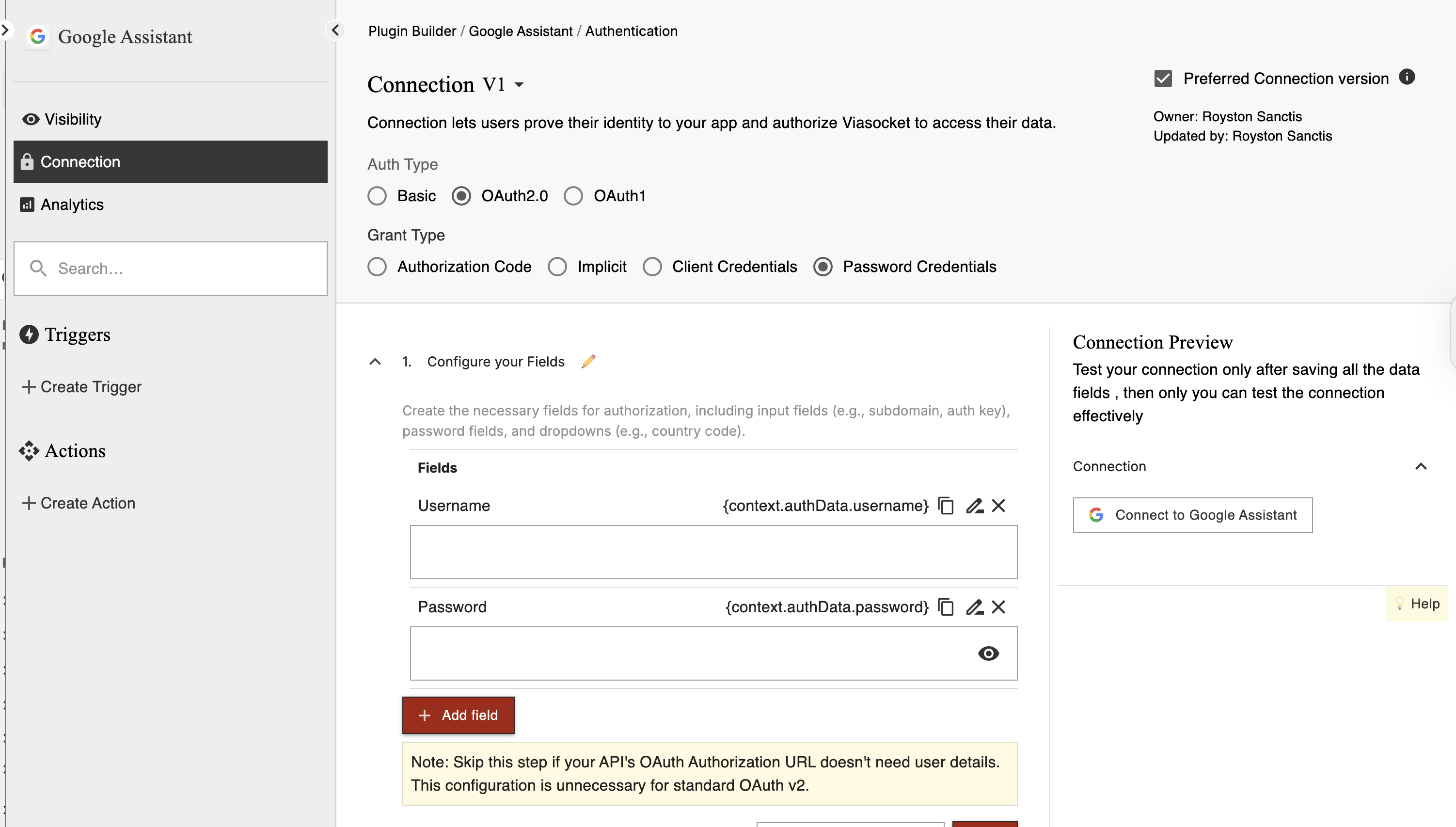
⚙️ Setup Steps
Purpose:
Also known as the Resource Owner Password Credentials (ROPC) flow, this grant type allows exchanging a username and password directly for an access token.
It’s generally deprecated for modern apps because it bypasses the provider’s login UI and puts full responsibility for credential handling on your app.
Recommended only for legacy systems or trusted environments.

Step 1 — Configure Fields (optional)
Add extra fields only if needed.
👉 Example:
Environment (sandbox / production)
Region
💡 Keep it minimal — users shouldn’t fill unnecessary inputs
Step 2 — Add Token URL
The endpoint where viaSocket sends the Client ID and Client Secret to obtain an access token.
Example:
https://service.com/oauth/token👉 viaSocket sends the code
👉 App returns an access token👉 This token is used to access user data
Tip: Use HTTPS to ensure credentials are secure in transit.
Step 3 — Add Refresh Token URL
Usually not required because Client Credentials flow can request a new token any time.
Used when the access token expires
👉 Keeps the connection active
👉 User doesn’t need to log in again
Step 4 — Add Revoke Token URL
Used to disconnect users
👉 Stops further API access
Recommended for security if users may disconnect integrations.
Step 5 — Add Test API
Add a test endpoint to verify the connection.
👉 Example:/me or /profile
This is used to check if credentials are valid
💡 Choose a simple endpoint that always returns data
Step 6 — Add Connection Name
Define how the connection will appear to users.
👉 Example: John’s Account
👉 Use dynamic values like name or email if available
Step 7 — Add Allowed URLs
Add the API base URLs your integration will use.
Only include required domains
Avoid unnecessary URLs
✔ Helps keep your connection secure
💡 Prevents unwanted or unsafe calls
Step 8 — Add Unique Identifier
Used to identify each user connection
👉 Example:
email
account_id
👉 Helps avoid duplicate connections
Step 9 — Set Request Parameters (optional)
Use this to automatically include values in every API request.
What does this do?
It allows you to define default key-value pairs that are added to every request.
You can configure:
Headers
Query Parameters
Body
👉 These values are automatically applied to all requests made through this connection.
Common examples
Header authentication
Authorization: Bearer {{access_token}}API key
api_key: {{api_key}}Static parameter
version: v2When to use this
Same headers are required in every request
You want to avoid repeating authentication logic
Your API needs fixed parameters
When NOT to use this
Values change per request
Different endpoints need different values
⚠️ Don’t add sensitive data here
Extra Best Practices
Avoid in Public Apps: This flow requires full trust between your app and the user.
Only for Legacy/Trusted Systems: Use OAuth Authorization Code flow for modern integrations.
Credential Storage: Always encrypt stored passwords; never log them.
MFA Considerations: If the account uses MFA, this flow may not work unless the provider supports passing OTP or other factors.
Register your application with the OAuth 2.0 authorization server to obtain a client ID and client Secret.