What It Actually Costs to Build an Integration (A Cost Model, Not a Range)
Search this question and you'll get numbers between $2,000 and $150,000. Both ends are real. Neither helps, because the published ranges hide the two variables that actually determine where you land: which third-party API you picked, and how many of your customers will eventually connect it.
This article gives you the model instead of the range. You'll get a way to score an API's difficulty before you write code, a fully loaded hourly rate you can defend, a three-year cost breakdown for a realistic integration, portfolio math for a full roadmap, and a build-vs-buy framework that doesn't assume the answer.
One thing to keep in mind while reading: most cost estimates published on this topic come from companies selling integration platforms, including the most widely quoted one. Merge's frequently cited $50,000-per-integration figure is built on 150 build hours, 300 maintenance hours, a $150,000 engineer salary, and 150 support tickets a year at two hours each. Those assumptions are reasonable for some integrations and badly wrong for others, and the number is worth exactly as much as the inputs behind it. So this article shows all of its inputs, and you should substitute yours.
Before you price anything, decide which of four things you're building
"We need a Salesforce integration" can describe an afternoon of work or two engineer-quarters. Most estimating failures start here, not in the code.
Tier | What it does | Typical scope | Baseline hours |
|---|---|---|---|
0 — Notify | One-way outbound push on an event | Post to a Slack channel, fire a webhook, create a row | 15–40 |
1 — Read | Authenticated one-way pull | OAuth flow, token refresh, paginated read of one or two objects, initial backfill | 60–130 |
2 — Sync | Two-way sync of standard objects | 2–4 objects, webhooks or delta polling, conflict handling, per-tenant field mapping, retry and dead-letter handling | 150–300 |
3 — Deep | Native, configurable, marketplace-grade | Custom objects and fields, bulk backfill, per-tenant configuration UI, admin permissions model, listing and review, support tooling | 400–1,000+ |
Baseline hours cover design, build, test, documentation, and internal enablement — not just the pull request. They assume a mid-level API, which is what the next section is for.
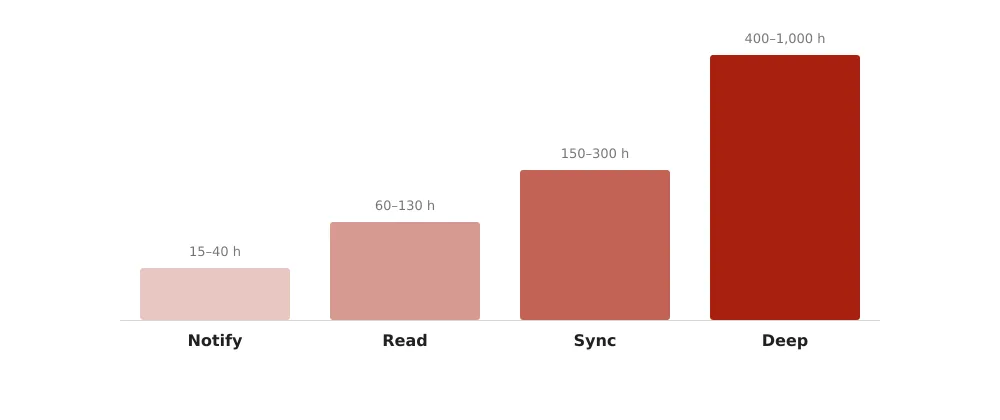
The tier ladder is also a scoping lever. A surprising share of customer integration requests are satisfied by Tier 0 or Tier 1. Teams default to Tier 2 because it sounds more complete, then spend a quarter building bidirectional sync that three customers use in one direction.
Adding integrations to your SaaS product
The API you're integrating with sets the price, not your team
Two Tier 2 integrations built by the same engineers, in the same week, can differ by 3x in effort. The variance lives almost entirely in properties of the third-party API — and those properties are knowable in an hour of reading documentation, before anyone commits to a sprint.
The API Difficulty Scorecard
Score each factor 1, 2, or 3. Total is 10 to 30.
# | Factor | 1 point | 2 points | 3 points |
|---|---|---|---|---|
1 | Auth model | Static API key or PAT | Standard OAuth 2.0 authorization code | Per-tenant app registration, OAuth 1.0a, signed JWT bearer, mTLS, or SAML-gated access |
2 | Tenancy model | Single global cloud host | Regional hosts or per-tenant subdomains | Self-hosted or on-prem versions in the wild with version drift |
3 | Change feed | Reliable webhooks with replay and delivery guarantees | Webhooks with no replay, or a clean | Polling only, with no reliable modification timestamp |
4 | Data model | Fixed, documented schema | Standard objects plus custom fields | Fully user-definable objects and layouts (Salesforce custom objects, NetSuite records) |
5 | Rate limits | Generous, documented, per-app | Tight but per-tenant and predictable | Shared org-level quota your customer's other vendors also consume |
6 | Write semantics | Read-only | Create-only, no dedupe requirement | Upsert, delete, and conflict resolution against concurrent edits |
7 | Test environment | Free, self-serve, persistent sandbox | Time-limited trial or developer account | Sandbox requires partner approval, payment, or a customer's instance |
8 | Partner gating | None | Free listing with a review process | Paid security review, revenue share, or annual listing fee |
9 | API stability | Versioned, long deprecation windows, published changelog | Versioned but frequent breaking changes | Unversioned or undocumented behaviour |
10 | Permission surface | Your user can self-authorize | Requires their admin's consent | Requires their IT team, a security review, or a scoped service account per install |
Turning the score into hours
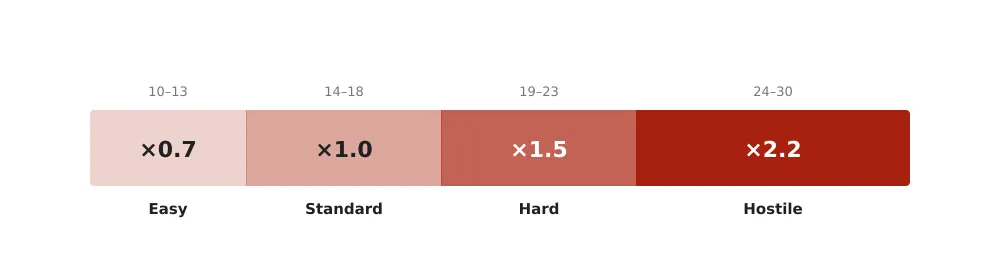
Score | Band | Multiplier | What it means in practice |
|---|---|---|---|
10–13 | Easy | ×0.7 | Modern, well-documented developer-first API |
14–18 | Standard | ×1.0 | The mainstream case; most popular SaaS APIs land here |
19–23 | Hard | ×1.5 | Budget for a discovery spike before committing to a date |
24–30 | Hostile | ×2.2 | Cut scope down a tier, or use a platform that already absorbed this |
Estimated hours = baseline hours for the tier × difficulty multiplier.
Worked example. A two-way contact-and-deal sync with a mainstream CRM that offers free developer accounts, webhooks, and custom properties scores roughly: auth 2, tenancy 1, change feed 1, data model 2, rate limits 2, write semantics 3, test environment 1, partner gating 2, stability 1, permissions 2 — 17, Standard, ×1.0. At a Tier 2 baseline of 220 hours, you're estimating 220 hours.
Now score a deep integration with an enterprise ERP: per-tenant app registration (3), on-prem versions in the field (3), polling only (3), user-definable records (3), shared quota (3), full upsert semantics (3), gated sandbox (3), paid partner program (3), unversioned edge behaviour (2), IT-mediated install (3) — 29, Hostile, ×2.2. Against a Tier 3 baseline of 550 hours, that's roughly 1,200 hours. Same company, same engineers, 5x the cost of the CRM integration.
That gap is the entire answer to "how much does it cost to build an integration," and no published range captures it.
What an engineering hour actually costs you
Salary is not cost. Use a fully loaded rate, or your estimate will be off by 40% before you start.
The U.S. Bureau of Labor Statistics puts the median annual wage for software developers at $135,980 as of May 2025. Load it with payroll taxes, benefits, equipment, software, and management overhead — conventionally a 1.25x to 1.4x multiplier — and you're at roughly $170,000 to $190,000. Divide by deliverable engineering hours, which is closer to 1,600 a year than 2,080 once you subtract PTO, holidays, meetings, on-call, interviews, and context switching.
Scenario | Loaded annual cost | Deliverable hrs/yr | Effective rate |
|---|---|---|---|
Offshore / nearshore team | $105,000 | 1,600 | ~$65/hr |
U.S. median developer | $180,000 | 1,600 | ~$113/hr |
Senior engineer, high-cost U.S. metro | $265,000 | 1,600 | ~$165/hr |
The examples below use $110/hour for engineering and $85/hour blended for support work that mixes customer success time with engineering escalation. Swap in your own.
The cost model
Year 1 cost of one integration =
    (build hours × engineering rate)
  + (fixed maintenance hours × engineering rate)
  + (connected tenants × support hours per tenant × blended support rate)
  + partner, listing, and sandbox fees
  + attributable infrastructure and observability
Applying it to the Standard CRM sync above — 220 hours, growing from 40 to 250 connected customers over three years:
| Year 1 | Year 2 | Year 3 |
|---|---|---|---|
Build (220 hrs @ $110) | $24,200 | — | — |
Fixed maintenance (60 hrs/yr @ $110) | $6,600 | $6,600 | $6,600 |
Connected customers | 40 | 120 | 250 |
Tenant support (1.2 hrs each @ $85) | $4,080 | $12,240 | $25,500 |
Infrastructure & observability | $1,200 | $1,400 | $1,700 |
Total | $36,080 | $20,240 | $33,800 |
Three-year cost: roughly $90,000. The build is 27% of it.
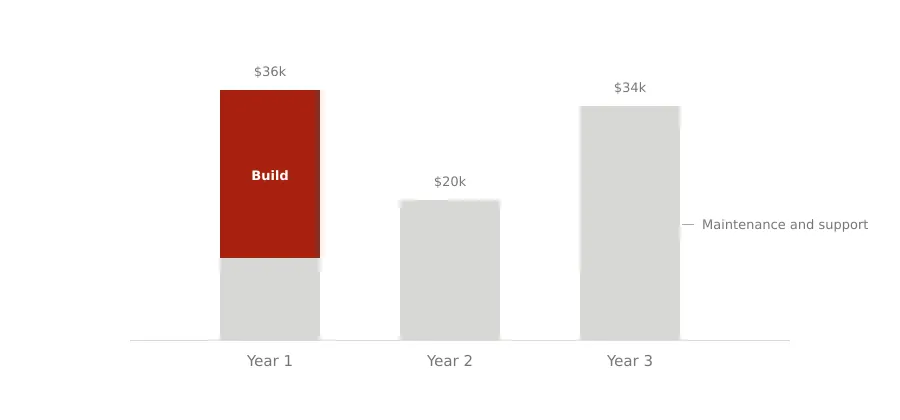
That ratio is the point. Teams approve integrations on the build number and are surprised by everything after.
Why "maintenance is 20% of build cost" is the wrong heuristic
Almost every article on this topic reuses the enterprise-IT rule that annual maintenance runs 15–25% of the original build. That rule comes from internal systems integration, where there is exactly one instance of the integration, running against one configuration of one CRM, used by one company.
A customer-facing integration is a different object. You are operating N instances, one per tenant, each with its own OAuth grant, its own field mappings, its own admin who revokes a scope on a Friday, its own volume against a shared rate limit. Maintenance splits into two terms that behave differently:
Fixed, per integration, per year — API version migrations, deprecated endpoints, scope changes, auth flow changes, keeping the connector current. Typically 30–120 hours depending on the vendor's release discipline. Independent of how many customers use it.
Variable, per connected tenant, per year — token expiry, permission drift, data that doesn't map cleanly, duplicate resolution, "the sync stopped last Tuesday." Typically 0.5–2 hours per connected tenant per year for a Tier 2 integration, mostly landing on support with an engineering escalation tail.
The consequence is counterintuitive: your most successful integration is your most expensive one. A connector nobody adopts costs you its fixed maintenance and nothing else. A connector half your base turns on costs you the fixed term plus a support line that grows with revenue. Budget accordingly, and price accordingly.
What it looks like across a roadmap, not a single integration
Single-integration math understates the problem, because integrations don't arrive alone. Research from Pandium found the median SaaS company offers around 15 integrations, with app-platform companies running into the hundreds.
Take a realistic mid-stage roadmap of 12 integrations:
Mix | Count | Baseline hrs each | Build hours | Fixed maint. hrs/yr each | Annual fixed maint. hrs |
|---|---|---|---|---|---|
Tier 1 (Read) | 4 | 90 | 360 | 35 | 140 |
Tier 2 (Sync) | 6 | 220 | 1,320 | 60 | 360 |
Tier 3 (Deep) | 2 | 550 | 1,100 | 110 | 220 |
Total | 12 |
| 2,780 |
| 720 |
At $110/hour:
Build: ~$306,000, or about 1.7 engineer-years of capacity.
Fixed maintenance: ~$79,000/year — roughly half an engineer, permanently allocated, before a single support ticket.
Tenant support: at an average of 60 connected customers per integration, 720 connections × 1.2 hours × $85 ≈ $73,000/year.
Combined run rate: around $152,000 a year, or one full-time engineer, to keep twelve integrations alive. Not to add any. Not to improve any. To keep them working.
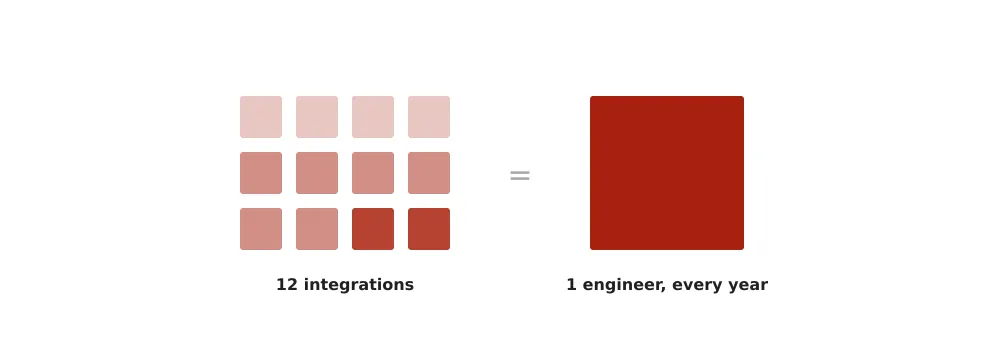
This is the number to put in front of a leadership team, because it's the one that changes decisions. The build is a project. The run rate is a permanent tax on roadmap capacity, and it compounds every time you say yes to a new logo on the integrations page.
The line items that don't show up in the engineering estimate
Partner programs and marketplace listings. Deep integrations with enterprise platforms usually require joining a partner program, passing a security review, and often paying a revenue share. Salesforce is the clearest example: listing a managed package on AppExchange requires a mandatory security review with a per-submission fee, an annual listing fee for paid apps, and a percentage revenue share on sales through the channel. Published figures for the review fee currently conflict across sources — some cite $2,550 and others $999 following a 2023 change — so confirm the current amount in the Salesforce partner documentation rather than trusting a blog. The larger cost is usually time: multi-week review cycles with a meaningful first-pass failure rate, sitting directly on your launch date.
Test environments. Free developer sandboxes are a gift. Where they don't exist, you're either paying for a seat on the platform you're integrating with, negotiating partner access, or — worst case — testing against a customer's production instance, which is a support incident waiting to be scheduled.
Compliance scope. Every integration that touches customer data in a new third-party system expands your security review surface. Vendor questionnaires get longer, subprocessor lists grow, and your SOC 2 scope moves. This is real cost, usually paid in security-team and legal hours rather than engineering hours, and it's almost never in the estimate.
Observability. Per-tenant logging, sync status, and replay tooling is the difference between "the sync is broken" taking 10 minutes or 4 hours to diagnose. Teams skip it on integration one and pay for it on integration five. Build it as shared infrastructure, cost it once, and amortize it.
Customer-facing documentation and enablement. Setup guides, permission requirements, troubleshooting articles, sales enablement, and demo environments. Budget 10–15% on top of engineering for anything customers self-serve.
Sunset cost. You cannot quietly delete a customer-facing integration. Deprecation means migration paths, notice periods, and account-by-account conversations. Assume anything you ship, you own for years.
What buying costs — and how each pricing model behaves as you grow
The buy side is genuinely cheaper for most teams at most scales. But "cheaper" depends entirely on the billing unit, because the billing unit determines whether your platform bill tracks your revenue or outruns it.
Note that most embedded integration platforms don't publish pricing at all. Paragon, Prismatic, Workato Embedded, and Tray Embedded are all quote-based, which is itself a budgeting cost — you cannot model them without a sales cycle.
Model | Billed on | Grows with | Fails you when | Publicly priced examples |
|---|---|---|---|---|
Per linked account | One customer ↔ one app | Customers × apps per customer | High adoption meets low ACV | Merge — $650/mo base, then per-account |
Per connection + metered usage | Connections, requests, compute, records | Sync chattiness as much as customer count | Volume is hard to forecast; several meters move at once | Nango — Starter from ~$50/mo, then per-connection and per-request |
Per consumer | Your end customer, regardless of app count | Customer count only | Many small customers each connecting one app | Apideck — from ~$599/mo |
Per integration instance | Customer × integration deployed | Same shape as per-linked-account | Broad app coverage with wide adoption | Prismatic (quote-based) |
Platform fee + per connector | Connectors in your catalogue | Roadmap breadth | Long-tail apps requested by single customers | Tray Embedded (quote-based) |
Flat tier + usage overage | Active users and task volume | Usage, not roadmap breadth | Very chatty workflows push you through tiers | ViaSocket Embed — Sandbox free, Production $249/mo, overage per extra user and per 2,500 tasks |
Per connector, flat annual | Connectors licensed | Roadmap breadth only | Narrow roadmap, huge volume (this model wins here) | Truto — per-connector annual |
Pricing is as published at the time of writing and changes frequently. Verify on each vendor's pricing page before modelling.
The gross-margin test
Whichever model you pick, run this before signing:
Platform cost per connected customer per month
  ÷ integration-attributable revenue per customer per month
  = integration COGS ratio
Keep it under roughly 20% and integrations stay a margin-accretive feature. Push past 50% and you've built a business that resells someone else's infrastructure at cost.
The arithmetic is unforgiving in one specific case: per-account pricing against a low-ACV product. If your average customer connects two apps and you're paying $65 per linked account, that's $130 a month in COGS per customer. Charge a $50 add-on for integrations and every activation loses money. Sell $80,000 ACV to enterprises where each customer connects one app, and the same $65 is a rounding error against the deal it unblocks.
Neither model is wrong. They're priced for different shapes of business, and the mistake is picking one without doing the division.
Build vs. buy: the six questions that actually decide it
Skip the generic advice. These six answers determine the outcome.
1. Is the integration your product, or plumbing for your product? If a customer would name the integration as a reason they bought — a data platform whose warehouse connectors are the value — build it. You need control of the semantics, the performance envelope, and the roadmap. If it's the fourteenth CRM connector in a marketplace, it's plumbing, and plumbing is a commodity you should be renting.
2. How many integrations will you carry in 24 months? One or two, permanently: build. The portfolio math above never triggers. Five to fifteen: this is where the fixed maintenance term starts consuming a permanent fraction of an engineer, and where buying usually wins. Fifty-plus: you're building an app platform, and the question becomes which layers to buy, not whether to.
3. What do your customers' APIs score? Run the scorecard across your top ten requested integrations. A roadmap averaging 14–17 is buildable. A roadmap averaging 22+ means you'd be paying to solve problems a platform has already solved a hundred times.
4. How deep does the logic go? Reading normalized objects out of a category — HRIS, CRM, accounting — is what unified APIs are for. Letting your customers build their own multi-step workflows across their own stack is what an embedded integration layer is for. Arbitrary custom business logic against one API's exact semantics is what building is for. Choosing the wrong layer costs more than choosing the wrong vendor.
5. What's your data residency and compliance posture? Some platforms cache customer data; some proxy it without storing it; some can be self-hosted. If you sell into healthcare, finance, or the public sector, this constraint can eliminate most of the market before price enters the conversation.
6. What is the pipeline actually worth? The cost of not shipping is the missing side of every build-vs-buy spreadsheet. Estimate it directly:
Annual blocked pipeline
  = deals per quarter where the integration is a stated requirement
  × the win-rate delta with vs. without it
  × average contract value
  × 4
Add renewal risk: accounts at renewal citing the gap × ACV × probability the gap tips them. Survey data from the State of SaaS Integrations report (published by Partner Fleet, Paragon, and PartnerStack) suggests integrations come up in a majority of sales conversations — treat vendor-sponsored survey figures as directional, but the direction is right. If the blocked pipeline dwarfs the build cost, stop optimizing the build cost and ship something.

Where building genuinely wins: a small number of strategically important integrations, a team with real API expertise, a compliance posture that rules out third-party data handling, or a unit economics profile where per-account platform pricing would eat the margin on the feature.
AI agents changed the shape of the cost curve
Two things happened at once, and they push in opposite directions.
Coding assistants compressed authoring. Writing the connector — the client, the pagination loop, the mapping layer — is meaningfully faster than it was two years ago. Realistically this cuts the build term, the smallest term in the three-year model, by some fraction. It does not touch the fixed maintenance term, because an API deprecation still requires someone to notice, decide, migrate, and verify. It does not touch the per-tenant support term at all, because that work is diagnostic and customer-facing.
If your estimate assumes AI cuts total integration cost by half, re-read the three-year table. The build was 27%.
Agent products inverted the breadth-depth tradeoff. A traditional SaaS integration goes deep on a few apps. An AI product that takes actions on a user's behalf needs shallow write access across dozens or hundreds of apps, each with per-user auth, each with an audit trail, each with permission scoping. Depth per app collapses; count explodes.
That shift makes the fixed maintenance term dominant, which is exactly the term platforms exist to absorb. It's also why MCP has become the connective tissue for this class of product: a standard way to expose tools to a model beats hand-writing a tool schema per app per product.
This is where viaSocket fits for teams in that position — it exposes an embeddable integration layer in three modes: your agent calling user-connected apps as tools, your backend triggering user-built workflows via webhook, or your users building multi-step automations inside your product against a catalogue of pre-built apps. The relevant cost property is that it's billed on active users and tasks rather than per connected account, so the bill tracks usage rather than multiplying with every app each customer turns on. Whether that model suits you is the gross-margin division above, not a matter of preference.
Seven mistakes that blow up integration estimates
1. Pricing the happy path. The demo takes a week. Token refresh failures at 3am, partial syncs, rate-limit backoff, duplicate resolution, and a customer's admin revoking a scope take the other seven. Estimate the failure modes, not the flow.
2. Treating maintenance as a percentage of build cost. Covered above. Model it as fixed-per-integration plus variable-per-tenant, or you will systematically underfund your most successful connectors.
3. Extrapolating from integration number one. The first integration carries the platform cost — auth storage, secrets, job scheduling, retry semantics, observability — and looks expensive. The second looks cheap because it reuses all of it. The tenth is expensive again, for a different reason: you've exhausted the easy APIs and you're into the long tail.
4. Ignoring the tenant multiplier. Per-tenant field mappings, per-tenant quirks, per-tenant quota. Anything that scales with connected customers has to be in the model explicitly.
5. Counting only engineering hours. Support, documentation, security review, sales enablement, and partner management are 20–40% on top of the engineering number for anything customer-facing.
6. Forgetting you can never turn it off. Every integration you ship is a permanent obligation with a migration cost attached. "We'll deprecate it if it doesn't get traction" is not a plan you'll execute.
7. Assuming your team's estimate accounts for the API. Engineers estimate their own work accurately and the third-party's behaviour optimistically. The scorecard exists to make that bias visible before the sprint, not after.
Build a defensible estimate this afternoon
Name the tier. Notify, Read, Sync, or Deep. Write down what's explicitly out of scope.
Score the API. Ten factors, 30 minutes with the docs, one number.
Multiply. Baseline hours × difficulty multiplier = build hours.
Set your loaded rate. Salary × 1.3 ÷ 1,600.
Add fixed maintenance. 30–120 hours a year, based on the vendor's release cadence and your scorecard's stability line.
Project connected tenants across three years, then multiply by 0.5–2 support hours each.
Add the invisible items. Partner fees, sandbox costs, docs, security review, observability.
Run it against the buy side. Take your three-year total, divide by 36, and compare to the monthly platform cost at your projected customer count — using each vendor's actual billing unit, not their headline price.
If steps 1 through 8 take longer than an afternoon, you've found a Tier 3 integration and you should run a discovery spike before promising anyone a date.
The number that should actually change your decision
Two figures from the model above matter more than any headline range.
The first is that the build is roughly a quarter of what an integration costs over three years. Approving integrations on the build estimate is why teams that budgeted carefully still end up surprised.
The second is that twelve integrations consume about one full-time engineer a year just to keep working — before you add a thirteenth. That's the figure that changes roadmap conversations, because it converts an ambiguous "integration debt" complaint into a headcount number a leadership team can act on.
Neither figure argues for building or for buying on its own. What they argue for is modelling the per-tenant term explicitly, whichever way you go, and pricing integrations so the term is covered. If you build, you're funding it out of engineering capacity. If you buy, you're funding it out of gross margin. Both are defensible. Paying it without having planned for it is the expensive option.
If you're at the point of comparing that run rate against a platform bill, viaSocket Embed publishes its pricing and offers a free sandbox tier, so you can put a real number next to your own before committing to a sales cycle
Questions teams ask when budgeting integrations
How long does one integration take?
A Tier 1 read integration against a friendly API is one to two engineer-weeks. A Tier 2 two-way sync is typically four to eight weeks of calendar time including review and testing. A Tier 3 deep integration with a marketplace listing runs a quarter or more, with the partner review process often on the critical path. Merge's 2023 survey of product managers and engineers found that most respondents needed at least three weeks to bring a single integration to market, which is consistent with the Tier 1–2 range.
Is it cheaper to build or to buy?
Below roughly three integrations, building is usually cheaper in cash terms. Between five and fifteen, buying almost always wins because the fixed maintenance term starts consuming permanent engineering capacity. Above that, you're choosing which layers to buy rather than whether to.
What does it cost to maintain an integration?
Two terms: 30–120 engineering hours a year per integration regardless of usage, plus 0.5–2 hours per connected customer per year in blended support and escalation. For a Tier 2 integration with 100 connected customers at typical U.S. rates, that's roughly $15,000–$20,000 a year.
Why do published estimates vary from $2,000 to $150,000?
Because they're pricing different things. The low end is a one-way webhook against a modern API. The high end is a bidirectional sync with a legacy enterprise system including partner certification. Tier plus API difficulty explains nearly all of the spread.
Do AI coding assistants make this cheaper?
They compress the build, which is roughly a quarter of the three-year cost. Maintenance and per-tenant support are unaffected. Expect a meaningful discount on the smallest line item, not on the total.
Should I use a unified API, an embedded iPaaS, or build it myself?
Unified APIs suit normalized reads across a category — HRIS, CRM, accounting — where you want one data model and your customers don't need to configure anything. Embedded integration platforms suit products where customers connect their own tools and build their own workflows inside your app. Building suits integrations that are themselves the product. Many teams end up with two of the three, and that's a reasonable outcome, not a failure of strategy.
How much should integrations cost as a percentage of revenue?
There's no benchmark worth quoting here. Use the gross-margin test instead: platform and maintenance cost per connected customer, divided by the revenue you can attribute to integrations for that customer. Under 20% is healthy.
How many engineering hours does a Salesforce integration take?
Salesforce spans a wider range than any other single API, which is why the question has no single answer. Score it and the range resolves:
Read-only pull of standard objects (Contacts, Accounts, Opportunities) via OAuth: Tier 1, difficulty around 16, so 90–130 hours.
Two-way sync including custom fields and picklists: custom objects score a 3, upsert-with-conflict-resolution scores a 3, and the org-level API request allocation your customer's other vendors also consume scores a 3. Free Developer Edition orgs keep the sandbox line at 1. Total lands around 20–22, so Tier 2 at ×1.5: roughly 330 hours.
Managed package listed on AppExchange: Tier 3 at ×1.5 is around 825 hours, plus review cycle time on the critical path.
So "a Salesforce integration" is anywhere from two engineer-weeks to five engineer-months. Worth noting which factor drives it: the shared org-level API allocation makes Salesforce expensive to operate, not to build. That cost lands in the per-tenant term, where it grows with adoption.
What does an embedded iPaaS cost per month?
Published entry prices, as listed at the time of writing: Nango from around $50/month, ViaSocket Embed at $249/month for its Production tier, Apideck from around $599/month, Merge at $650/month for its base tier, and Cyclr reported from around $999/month. Most of the category doesn't publish at all — Paragon, Prismatic, Workato Embedded, and Tray Embedded are quote-based, and reported enterprise embedded contracts run well into five figures annually.
Treat the entry price as the least useful number in the comparison. A $50 plan billed per connection and a $650 plan billed per linked account can invert at 200 customers. Model the billing unit against your projected customer count and apps-per-customer, then run the gross-margin test.
Read More