
Everything You Need to Build Connected Products and Agents
Give your SaaS products and AI applications the infrastructure to connect apps, manage authentication, execute actions, and build AI-powered experiences.
Managed Authentication
2,300+ App Integrations
Custom Integrations & API Requests
Triggers & Webhooks
Multi-tenant Support
Custom Branding & UX
AI Agents
In-app AI Chatbots
Browser Actions
Real-time Action Execution
Background Execution & Retries
Scheduled Execution
Managed Data Mapping
Execution Replay
Execution Monitoring & Debugging
Regional Deployment
Learn more about building connected products
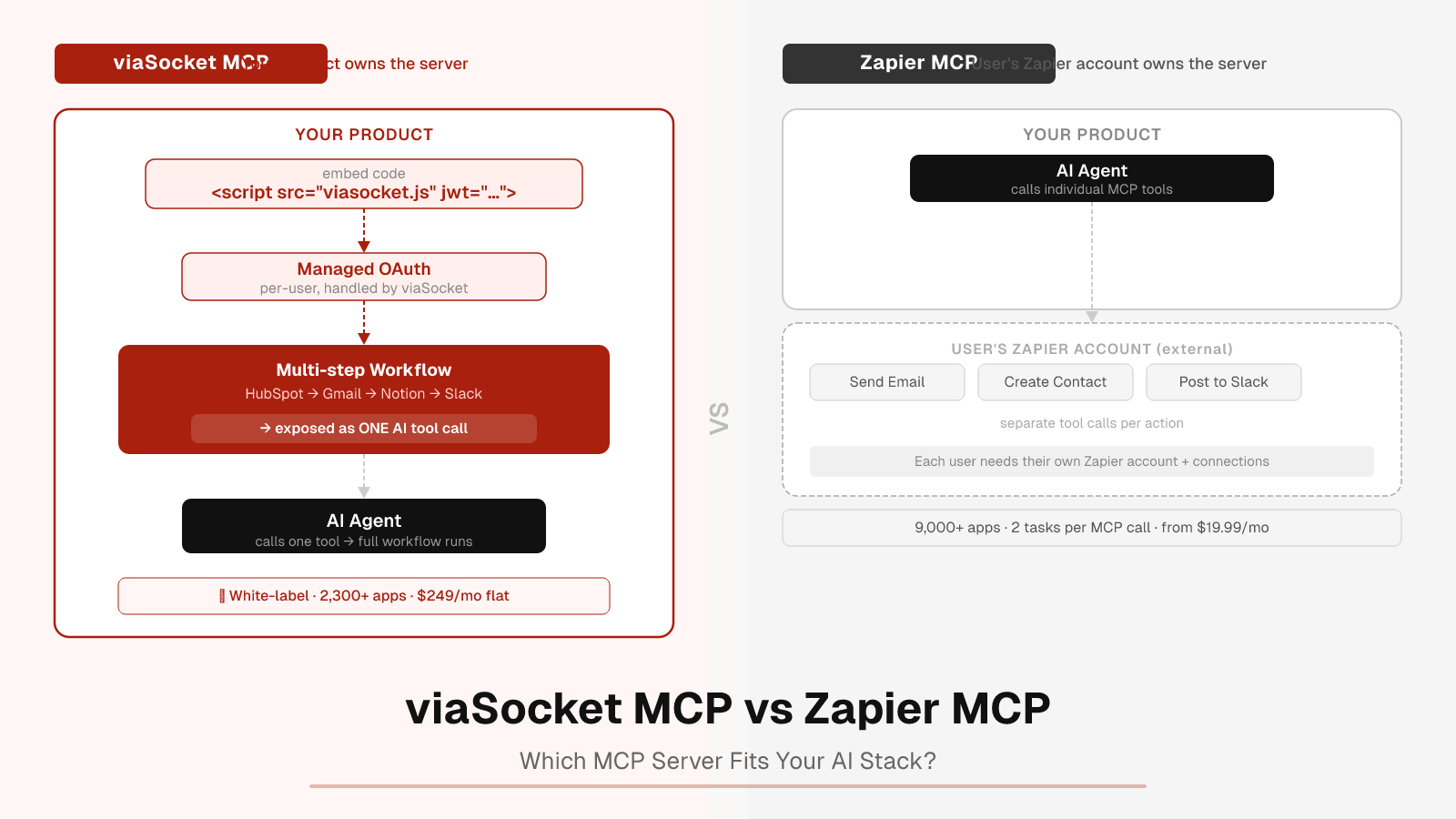
viaSocket MCP vs Zapier MCP — Which MCP Server Fits Your AI Stack?
A structured comparison of viaSocket MCP and Zapier MCP for developers and AI agent builders: app coverage, pricing, embedded use, white-label options, and setup complexity — with clear guidance on which fits your use case. By Abhijeet SinghRead article →

Browser Automation for AI Agents: How to Act on Sites That Have No API
A practical guide for developers building AI agents that need to act on websites with no public API. Covers when to use browser actions vs API calls, per-user isolation, monitoring, and how viaSocket manages browser automation as part of a broader agent tool stack.By Abhijeet SinghRead article →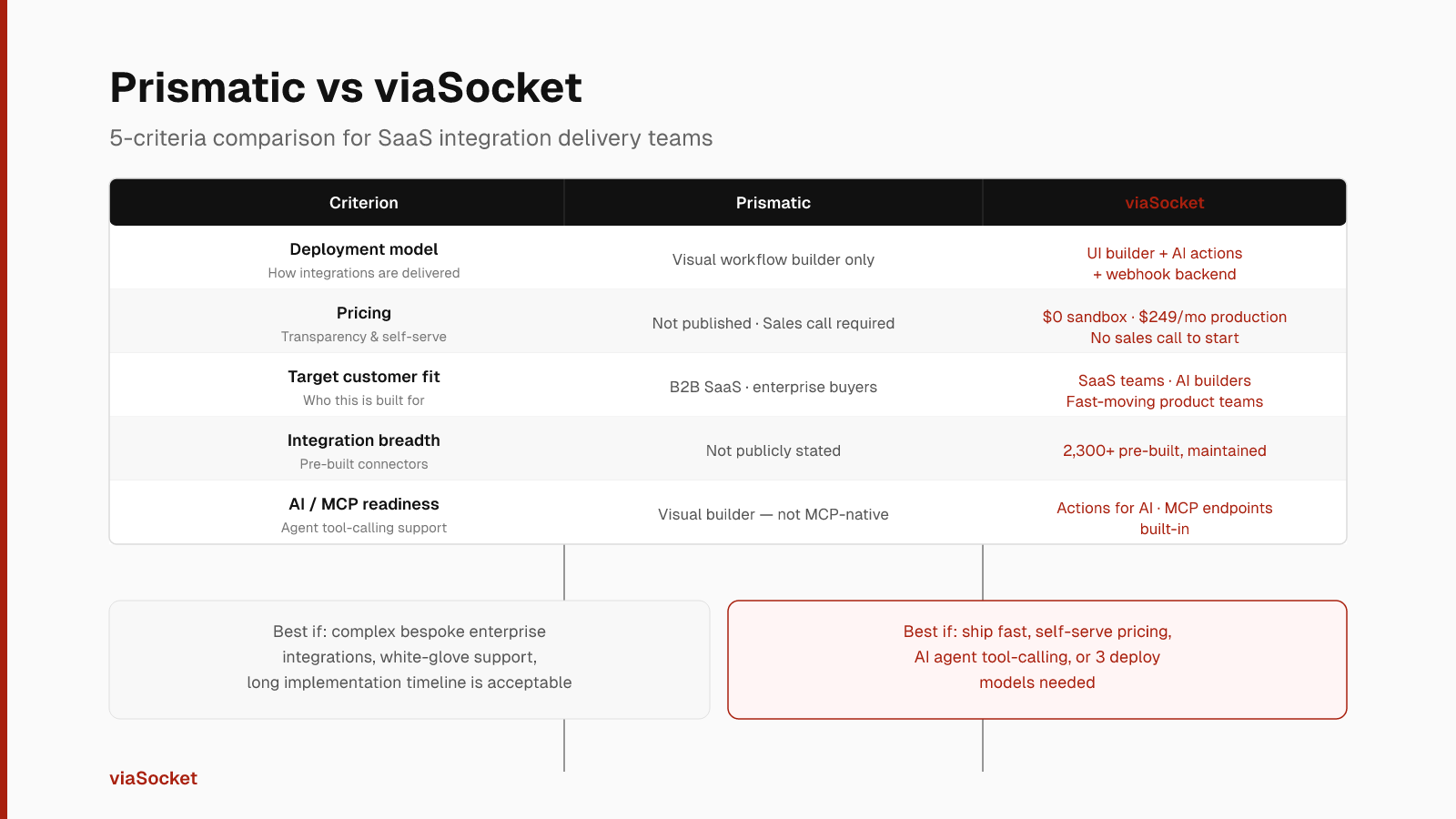
Prismatic Alternative: viaSocket vs Prismatic for SaaS Integration Delivery
Evaluating Prismatic alternatives? This comparison covers viaSocket vs Prismatic across five criteria — deployment model, pricing, integration breadth, target customer fit, and AI/MCP readiness — to help SaaS teams make a grounded choice.By Abhijeet SinghRead article →FAQs about viaSocket features
What is an integration layer?
An integration layer provides the infrastructure needed to connect a product to third-party applications. It handles capabilities such as authentication, data mapping, action execution, triggers, and monitoring, allowing developers to build integrations without managing every underlying component themselves.
How many apps does viaSocket support?
viaSocket supports integrations with more than 2,300 apps, allowing developers to connect their products to a wide range of third-party services.
Can I build custom integrations with viaSocket?
Yes. You can connect services beyond the existing integration catalog and make additional API requests when pre-built actions don't meet your requirements.
How does viaSocket handle authentication?
viaSocket provides managed authentication capabilities, including authentication flows and token management, reducing the need to build and maintain these mechanisms separately for every integration.
Does viaSocket support multi-tenant applications?
Yes. viaSocket supports managing separate connected accounts and integration configurations for different customers, making it suitable for SaaS products serving multiple tenants.
Can I customize the integration experience?
Yes. You can customize the integration experience to align with your product's branding and user interface, depending on your implementation requirements.
Can I add AI chatbots and agents to my product?
Yes. You can use viaSocket to give AI chatbots and agents access to your product's capabilities and connected applications, enabling tasks such as retrieving information, drafting emails, scoring leads, and updating records.
Does viaSocket support MCP?
Yes. viaSocket supports MCP capabilities that allow compatible AI clients and agents to access supported tools and integrations.
Can viaSocket interact with websites without APIs?
Yes. Browser automation can enable interactions with websites when a suitable API isn't available.
Can I deploy viaSocket in different regions?
viaSocket supports regional infrastructure deployment to serve customers in their preferred regions, subject to available deployment options.
How can I monitor and debug integrations?
viaSocket provides execution monitoring and debugging capabilities to help developers inspect execution status, review logs, identify errors, and troubleshoot integration issues.
Does viaSocket support scheduled and background execution?
Yes. viaSocket supports scheduled execution and background processing, with retry capabilities for eligible failed executions.