Prismatic Alternative: viaSocket vs Prismatic for SaaS Integration Delivery
 By Abhijeet Singh
Jump to section
Prismatic Alternative: viaSocket vs Prismatic for SaaS Integration Delivery
Prismatic is a well-regarded embedded iPaaS platform built specifically for B2B SaaS companies. If you're evaluating Prismatic alternatives, you're likely in one of two situations: you've hit a pricing or scale threshold, or you need integration delivery capabilities — particularly for AI agents — that map differently to your product architecture.
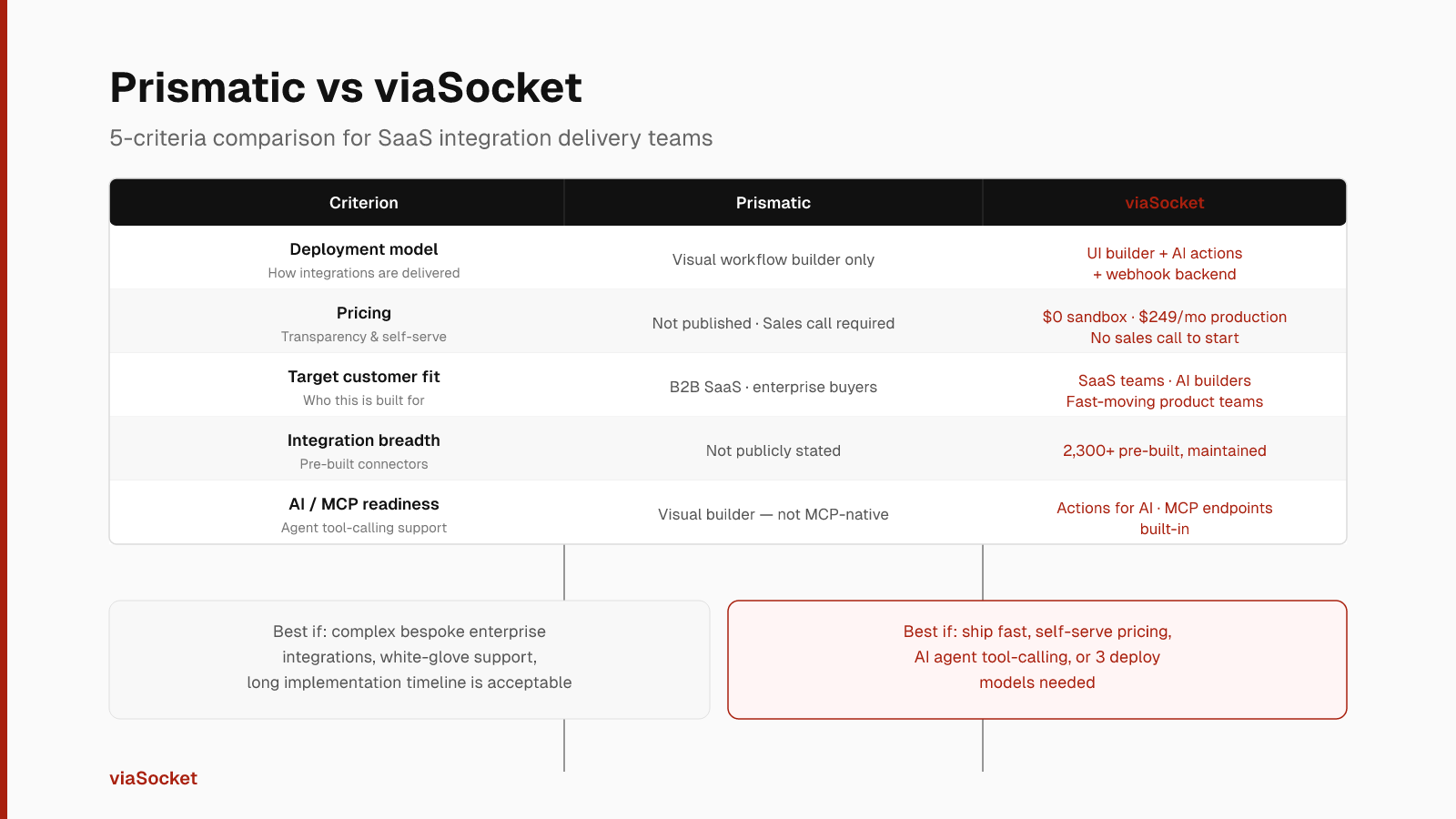
This comparison covers the five criteria that matter most for a SaaS team choosing integration delivery infrastructure: deployment model, pricing transparency, target customer fit, integration breadth, and AI/MCP readiness. It's written to help you make a grounded decision, not to oversell either product.
What Prismatic Is Built For
Prismatic is purpose-built for B2B SaaS companies that need to deliver integrations to enterprise customers. Its core strengths are:
- A white-labeled embedded workflow builder embedded in your product
- Deep support for custom connectors, including a low-code connector builder
- Enterprise-grade infrastructure with strong support for complex, long-running integration workflows
- White-glove onboarding and implementation support
- A marketplace model where your customers can discover and activate integration templates
Prismatic has a track record with B2B SaaS companies that need to deliver integrations to enterprise buyers who have complex, bespoke requirements.
If you need heavy customization per customer, dedicated customer success management, and an enterprise-grade SLA with hands-on support, Prismatic is a serious contender and should stay on your shortlist.
Where Teams Look for Alternatives
Teams typically look for Prismatic alternatives when:
-
Pricing requires a sales call. Prismatic does not publish pricing. Getting a quote requires a discovery call and sales qualification. For early-stage teams, seed-funded startups, or teams that want to prototype before committing, this is a friction point.
-
AI agent integration delivery model. Prismatic offers MCP capabilities for AI integration, including an MCP flow server that exposes your deployed integration workflows as tools for AI agents to invoke. But the model is workflow-centric: you build and deploy a flow, then AI agents call it. Teams that need to give an AI agent direct, dynamic access to actions across hundreds of apps — without pre-building a flow for each one — need a different integration delivery architecture.
-
Speed to production. Enterprise-grade platforms with custom connector builders and white-glove onboarding have implementation timelines to match. Teams that need to ship integration capabilities in weeks rather than quarters look for alternatives with faster self-serve paths.
-
Transparent self-serve pricing. Growing SaaS teams often need to validate economics before sales engagement.
Five-Criteria Comparison: viaSocket vs Prismatic
1. Deployment Model
Prismatic offers an embedded workflow builder (white-labeled, embedded in your SaaS UI, Enterprise tier), a customer-facing integration marketplace, and a headless API for programmatic integration management. The primary model is workflow-builder-centric: your customers build and configure their own integrations within your product.
viaSocket offers three distinct deployment models:
- Embedded iPaaS — white-labeled workflow builder embedded in your SaaS, backed by 2,300+ pre-built connectors
- Actions for AI — AI agent tool-calling across 2,300+ apps, with per-user managed auth
- Actions via Webhook — backend webhook fires multi-app actions; no UI embedding required
For visual workflow builder delivery to end customers, both platforms compete directly. Prismatic has a longer track record in this model; viaSocket offers it as one of three options.
2. Pricing Transparency
Prismatic does not publish pricing. A sales call is required. This is standard for enterprise platforms targeting B2B SaaS at scale, but it creates friction for early-stage teams and makes cost modeling difficult pre-commitment.
viaSocket Embed pricing is published:
- Sandbox: $0/month — 25 active users, 25K tasks/month
- Production: $249/month — 1,000 active users, 1M tasks/month
- Enterprise: Custom
Overages are $1 per user and $1 per 2,500 tasks. No sales call required to start. Full pricing is at /embed/app-integration.
The main viaSocket automation pricing (separate from Embed) starts at $0/month with 100,000 tasks included. Full details at /pricing.
3. Target Customer Fit
Prismatic is optimized for B2B SaaS companies delivering integrations to enterprise customers. The platform assumes complex, bespoke integration requirements per customer, a dedicated integrations team, and an implementation timeline of weeks to months.
viaSocket is optimized for:
- SaaS founders and product teams who need integration capabilities without a dedicated integrations team
- AI-native products (copilots, agents) that need to act on third-party apps
- Platform engineers who need managed OAuth and multi-tenant integration infrastructure
- Teams that want to ship and iterate quickly with published pricing
Prismatic's strengths — enterprise support, deep customization per customer, white-glove onboarding — are genuine advantages for the right buyer. If your customers are enterprises with complex, negotiated integration requirements, Prismatic is worth the sales conversation.
If your customers are SMBs or mid-market, or if you're building a product where integrations need to be mostly self-serve and low-touch, viaSocket's model is likely a better fit.
4. Integration Breadth
Prismatic supports pre-built connectors (their Component Library) across common B2B categories, plus a low-code connector builder for custom integrations. The emphasis is on quality and configurability per connector rather than breadth.
viaSocket provides 2,300+ pre-built app integrations maintained by the platform — CRM, marketing, support, finance, HR, developer tools, communication, and more. You add them to your product; you don't build or maintain them. See /features for the integration catalog.
For teams whose customers use a wide, unpredictable variety of apps, breadth matters. For teams whose customers use a predictable set of enterprise tools with complex configuration requirements, Prismatic's connector depth may matter more.
5. AI/MCP Readiness
Both platforms offer AI and MCP integration capabilities, but the underlying delivery model is different — and that difference matters depending on what you're building.
Prismatic has invested significantly in AI for integrations. Their platform offers two distinct MCP capabilities: an MCP dev server that connects AI coding assistants (Claude, Cursor) to Prismatic inside a developer's IDE, accelerating how integration workflows are built; and an MCP flow server that exposes your deployed integration workflows as structured tools that your customers' AI agents can discover and invoke at runtime. They also provide built-in connectors for OpenAI, Anthropic, Google Gemini, LangChain, and other AI services. MCP server support is included from the Scale plan.
The model is workflow-centric: a developer builds and deploys a Prismatic integration flow, and then an AI agent can call that flow via the MCP flow server. This gives you tight control over execution logic, error handling, and business rules inside each tool the AI can invoke.
viaSocket takes a different architectural approach with three distinct AI delivery patterns:
- Actions for AI — exposes 2,300+ individual app actions as tool calls for your AI agent, with per-user managed OAuth. The agent calls actions directly; no pre-built flow is required for each action.
- White-label MCP endpoint — a user-facing MCP server your customers can connect their own AI clients to, surfacing your product's integrations as an MCP endpoint.
- Actions via Webhook — a backend webhook model for triggering multi-app actions without any UI or AI client layer.
The practical distinction: if you need to give an AI agent dynamic, on-demand access to actions across a wide catalog of apps without the overhead of pre-authoring a flow for each integration, viaSocket's direct-action model fits that pattern. If your AI agents should call reliable, pre-defined integration workflows with structured business logic you control, Prismatic's MCP flow server is designed for that.
Neither model is universally superior — they reflect different trade-offs between control and flexibility.
Summary: Which to Choose
| Criterion | Prismatic | viaSocket |
|---|---|---|
| Deployment model | Workflow builder (Enterprise) + marketplace | Workflow builder + AI actions + Webhook |
| Pricing transparency | Sales required | Published, starts free |
| Target customer size | Enterprise B2B SaaS | SMB to enterprise SaaS + AI products |
| Integration breadth | Curated connectors + custom builder | 2,300+ pre-built |
| AI/MCP readiness | MCP server support (Scale+); MCP flow server exposes deployed workflows as AI tools | Multi-modal: tool-calling endpoint, white-label MCP endpoint, webhook — no pre-built flow required |
| Embedded workflow builder | Enterprise tier only | Available on all Embed plans |
| White-glove onboarding | Strong | Limited |
| Self-serve path | Limited | Strong |
Choose Prismatic if: You're selling to enterprise customers with complex, bespoke integration requirements; your team has implementation capacity; and you need white-glove support and customer success management as part of the vendor relationship. If your AI agents need to call tightly controlled, pre-defined integration workflows with deterministic business logic, Prismatic's MCP flow server is purpose-built for that.
Choose viaSocket if: You need transparent self-serve pricing, a wide pre-built integration catalog, or a faster path from prototype to production. If your AI agent needs dynamic access to actions across a broad set of apps without pre-building a flow for each integration, viaSocket's Actions for AI model is the better fit.
Getting Started with viaSocket
The Embed Sandbox is free: $0/month, 25 active users, 25K tasks — enough to prototype a complete embedded integration experience.