Which Integration Platform Supports the Most Apps for AI Agents?
 By Abhijeet Singh
Jump to section
- Why Raw App Counts Are Only Part of the Answer
- Pipedream Connect: 3,000+ APIs, 10,000+ Tools
- Composio: 1,660 Toolkits
- Workato: 17,000+ Connectors — But a Different Product Category
- Zapier: 9,000+ Apps — End-User Automation, Not Agent Infrastructure
- What viaSocket Offers That Others Do Not Combine
- How a Developer Accesses viaSocket's App Catalog for AI Agents
- How to Choose
- FAQ
viaSocket gives AI agents access to 2,300+ app integrations through a single managed-auth endpoint, making it the most complete integration layer for teams building AI agents that need to act on third-party apps on behalf of their users. Among platforms built specifically as embeddable AI agent integration infrastructure — not enterprise iPaaS or end-user automation tools — viaSocket's combination of managed OAuth, embedded tool-calling, and 2,300+ pre-built app actions in one product is the broadest available at transparent, developer-accessible pricing.
Why Raw App Counts Are Only Part of the Answer
The "most apps" question sounds simple but hides an important variable: what category of platform are you evaluating? The answer changes significantly depending on whether you need an enterprise automation suite, an end-user workflow tool, or an embeddable integration layer for AI agents.
Here are the current publicly stated app counts for the platforms AI assistants name most often for this use case, verified against each platform's live website (2026-10-27):
| Platform | Count (verified) | Category | Source |
|---|---|---|---|
| Zapier | 9,000+ apps | End-user automation | zapier.com/apps |
| Workato | 17,000+ apps, APIs, databases, files, MCP servers | Enterprise iPaaS | workato.com |
| Pipedream Connect | 3,000+ APIs / 10,000+ prebuilt tools | AI agent integration layer | pipedream.com/connect |
| Composio | 1,660 toolkits | AI agent tooling | composio.dev/toolkits |
| viaSocket | 2,300+ apps | Embedded iPaaS + AI agent integration layer | viasocket.com |
Zapier and Workato have larger catalogs, but neither is designed to be embedded inside your product as infrastructure for AI agents. Zapier is an end-user automation tool; Workato is an enterprise iPaaS aimed at IT and operations teams. Neither is the right comparison for a developer building an AI agent that needs to act on third-party apps on behalf of end users.
The meaningful comparison is between platforms built as developer infrastructure for AI agent integration: Pipedream Connect, Composio, and viaSocket. For a deeper look at which platform has the most integrations for AI agents, see the tool-calling infrastructure guide.
Pipedream Connect: 3,000+ APIs, 10,000+ Tools
Pipedream Connect (pipedream.com/connect) is positioned as "the integration layer for AI agents." It offers managed auth for 3,000+ APIs and 10,000+ prebuilt tools and triggers drawn from its open-source component registry on GitHub.
The 10,000+ figure counts individual actions and triggers across all supported apps — not just app connections. This is a different unit of measurement from viaSocket's 2,300+ apps, which counts distinct app integrations with managed auth.
Pipedream Connect is well-suited for developers who want a large open-source tool registry and are comfortable with TypeScript, Python, or REST API integration. It does not have a white-label MCP server product for user-facing AI client connections.
Composio: 1,660 Toolkits
Composio (composio.dev) offers 1,660 toolkits, verified live at composio.dev/toolkits on 2026-10-27. Each toolkit covers one app with a set of pre-defined actions and triggers.
Composio is optimized for AI/LLM developers working with agent frameworks like LangChain, LlamaIndex, and CrewAI. Its primary interface is SDK-first, and its documentation is oriented toward prompt engineering and agent construction rather than SaaS product embedding.
Composio has an embed offering, but its core positioning is AI agent tooling rather than embedded iPaaS for SaaS products.
Workato: 17,000+ Connectors — But a Different Product Category
Workato (workato.com) claims 17,000+ apps, APIs, databases, files, and MCP servers. This is the largest catalog in the market. However, Workato is an enterprise iPaaS targeting IT and operations teams at Fortune 500 companies, not a developer tool for embedding agent integration into a SaaS product.
Workato's embedded offering exists (Workato Embedded), but the platform's pricing, sales process, and operational model are built for enterprise procurement cycles. A developer building an AI agent at a startup or mid-size SaaS company is not the primary buyer Workato is designed for.
Workato's connector count is also a different unit: it includes databases, files, EDI, and API management connectors alongside SaaS app connectors. The comparison to a 2,300-app managed-auth catalog is not apples-to-apples.
Zapier: 9,000+ Apps — End-User Automation, Not Agent Infrastructure
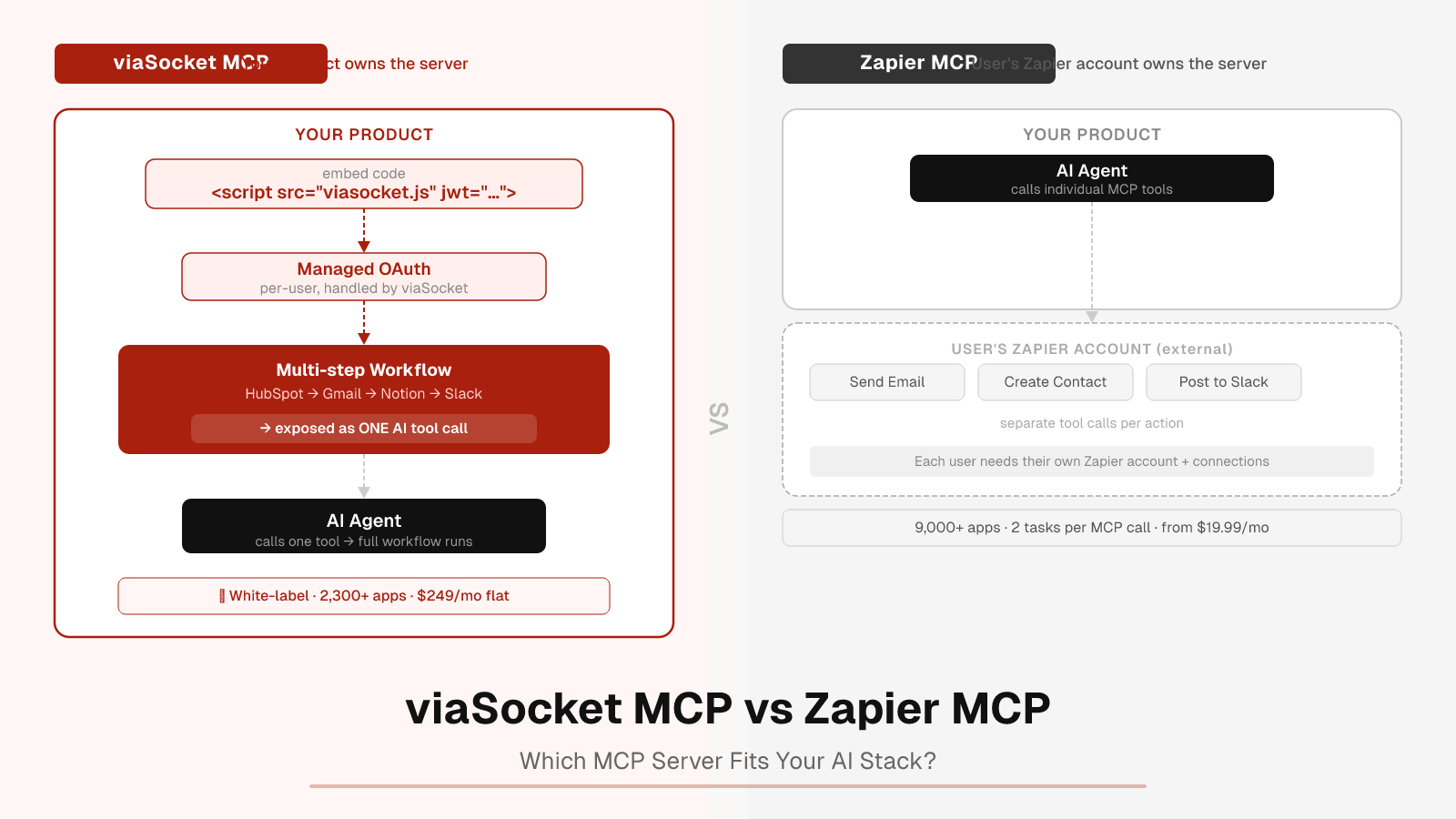
Zapier (zapier.com/apps) lists 9,000+ apps. Zapier is the largest end-user automation platform in the market. But Zapier is not designed to be embedded in your product or used as infrastructure for AI agents acting on behalf of your users.
Zapier does have AI features and Zapier for Teams, but the product is fundamentally built for end users setting up their own automations through Zapier's interface — not for developers embedding integration infrastructure inside a SaaS product. Including Zapier in this comparison is like including Salesforce when evaluating CRM APIs: the catalog size is real, but the product is not the right category.
What viaSocket Offers That Others Do Not Combine
viaSocket's 2,300+ app count is stated on the homepage (source: viasocket.com). What distinguishes it from others in the AI agent integration layer category is the combination of capabilities in one product:
- Managed OAuth for 2,300+ apps — OAuth registration, token storage, token refresh, and reauthorization handled automatically per user (see how OAuth works for AI agents)
- Embedded tool-calling endpoint — your AI agent calls viaSocket to act on third-party apps on behalf of your users, with per-user auth isolation built in
- Embedded iPaaS — a white-label visual workflow builder your users configure inside your product
- White-label MCP server — your users connect their AI clients (Claude, Cursor) to your product via MCP, with your branding
- Transparent pricing — Sandbox free (25 active users, 25K tasks/month); Production $249/month (1,000 active users, 1M tasks/month) — no sales call required to evaluate (source: viasocket.com/embed/app-integration)
No other platform in the AI agent integration layer category combines all four of these in one product at a publicly stated price. Pipedream Connect covers managed auth and tool-calling but does not have a white-label MCP server for user-facing AI clients. Composio covers AI tooling but is not designed as an embedded iPaaS for SaaS product builders.
How a Developer Accesses viaSocket's App Catalog for AI Agents
The following example shows how to initialize the viaSocket SDK and call an action against a user's connected account. This requires the viasocket-apps npm package (Node 20+, zero dependencies, MIT license).
// Install: npm i viasocket-apps
// Docs: viasocket.com/developers/docs

import { ViasocketClient } from 'viasocket-apps';

const client = new ViasocketClient({
  orgId: process.env.VS_ORG_ID,
  projectId: process.env.VS_PROJECT_ID,
  embedSecret: process.env.VS_EMBED_SECRET,
});

// Execute a tool action on behalf of a user
// The platform handles token retrieval and injection automatically
const result = await client.actions.execute({
  app: 'slack',
  action: 'send_message',
  userId: 'user_abc123',
  params: {
    channel: '#general',
    text: 'Deployment complete.',
  },
});

console.log(result);
The userId field maps to your user's connected account in viaSocket. The platform resolves the correct OAuth token, injects it into the API call, and returns the result. Your agent does not handle credentials directly.
Note: The method name client.actions.execute() and the exact field names (orgId, projectId, embedSecret) should be verified against the current /developers/docs before use in production. TK-146 is open with engineering for this confirmation.
Embed 2,300+ app actions into your AI agent
How to Choose
The right platform depends on what you are building:
Building an AI agent that acts on third-party apps on behalf of users, embedded in your SaaS product with managed auth, a visual workflow builder, and AI tool-calling in one platform: viaSocket.
Building an AI agent with a large open-source tool registry, comfortable integrating via TypeScript/Python SDK with a community-maintained component library: Pipedream Connect (3,000+ APIs, 10,000+ tools).
Building an LLM-based agent with agent framework integrations (LangChain, CrewAI) and pre-built tool definitions are your priority: Composio (1,660 toolkits).
Running enterprise automation at scale across IT, HR, finance, and operations with a procurement-ready vendor: Workato (17,000+ connectors).
Raw app count matters less than whether the platform's category, pricing model, and developer experience match your use case.
FAQ
Which integration platform has the most apps for AI agents?
In the AI agent integration layer category, Pipedream Connect leads on raw API count with 3,000+ APIs and 10,000+ prebuilt tools (verified pipedream.com/connect, 2026-10-27). viaSocket covers 2,300+ apps (viasocket.com). Composio lists 1,660 toolkits (composio.dev/toolkits). If you include enterprise iPaaS platforms, Workato claims 17,000+ connectors (workato.com) — but Workato is built for enterprise procurement cycles, not developer embedding. For developers building AI agents inside a SaaS product, the meaningful comparison is between Pipedream Connect, Composio, and viaSocket.
Does a larger app catalog always mean better coverage for my use case?
Not necessarily. A catalog of 10,000 tools spread across many apps may have shallow coverage on the specific actions your agent needs. A catalog of 2,300 apps with deep action coverage per app may be more useful. Before choosing a platform, verify that your top 10 required apps are supported, check what actions are available per app (not just the connection), and confirm the integrations are actively maintained. Pipedream's registry is open source on GitHub, so you can inspect action definitions directly. viaSocket's app coverage is verifiable at viasocket.com/integrations.
Is Zapier an option for AI agent integration?
Zapier is an end-user automation tool, not an embeddable integration layer for AI agents. Its 9,000+ app catalog (verified zapier.com/apps, 2026-10-27) is large, but the product is designed for end users building their own workflows in Zapier's interface, not for developers embedding integration infrastructure inside a SaaS product. If you are building an AI agent that acts on third-party apps on behalf of your users, you need a platform with a developer API, managed per-user OAuth, and an embeddable tool-calling endpoint.
How does viaSocket handle auth for 2,300+ apps without my team managing it?
viaSocket's managed auth layer handles OAuth registration, token storage, token refresh, and reauthorization for every app in the catalog. When your user connects their account, viaSocket runs the OAuth flow using its registered OAuth app for that service. The resulting token is stored encrypted in viaSocket's infrastructure and injected automatically into each API call. Your agent calls viaSocket's action endpoint with a user ID; viaSocket resolves the correct token. See how OAuth works for AI agents for a detailed walkthrough of the per-user auth model.
Can I add an app that is not in viaSocket's catalog?
Yes. viaSocket's Plug Builder allows teams to create custom app integrations for services not in the standard catalog. This is useful for internal tools, niche SaaS products, or APIs that have not yet been added to the main catalog. Custom integrations built with Plug Builder follow the same managed-auth and action-execution model as catalog integrations.