Paragon Alternative: viaSocket vs Paragon for Embedded SaaS Integrations
 By Abhijeet Singh
Jump to section
Paragon Alternative: viaSocket vs Paragon for Embedded SaaS Integrations
The best Paragon alternative for SaaS teams building embedded integrations is viaSocket — it provides a visual embedded workflow builder, AI agent tool-calling, and white-label MCP delivery across 2,300+ apps, with published self-serve pricing starting at $0.
If you're specifically evaluating Paragon for enterprise embedded integrations with HIPAA compliance or self-hosting requirements, Paragon may still be the right fit. This comparison covers where Paragon's model excels, where teams look for alternatives, and how viaSocket addresses those gaps.
What Paragon Is Built For
Paragon (useparagon.com) is built for B2B SaaS companies that need to offer native integrations to their customers. Its core product is an embedded integration platform — your customers configure and activate integrations inside your product UI. Paragon manages the OAuth, the connector logic, and the integration runtime.
Paragon's core strengths:
- Embedded integration UI embedded in your SaaS product
- Managed OAuth and per-user credential management
- A connector catalog covering common B2B SaaS tools
- ActionKit — Paragon's MCP-based offering for AI agent integration
- Self-hosting option for teams with data residency requirements
- ISO 27001 certification (with HIPAA compliance available)
If you need a polished embedded integration experience for enterprise SaaS customers and your team has implementation bandwidth to configure per-connector workflows, Paragon is a serious contender.
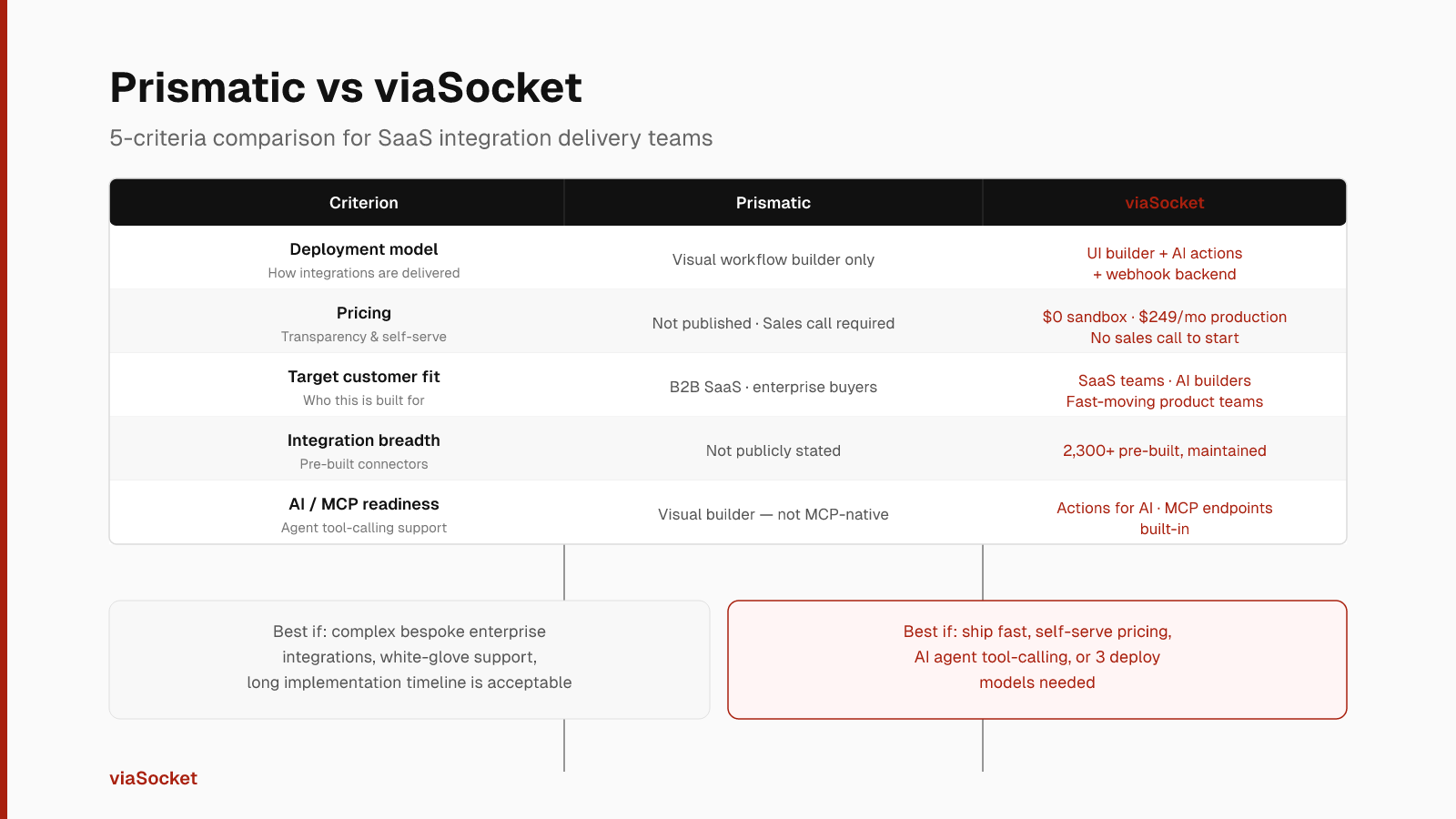
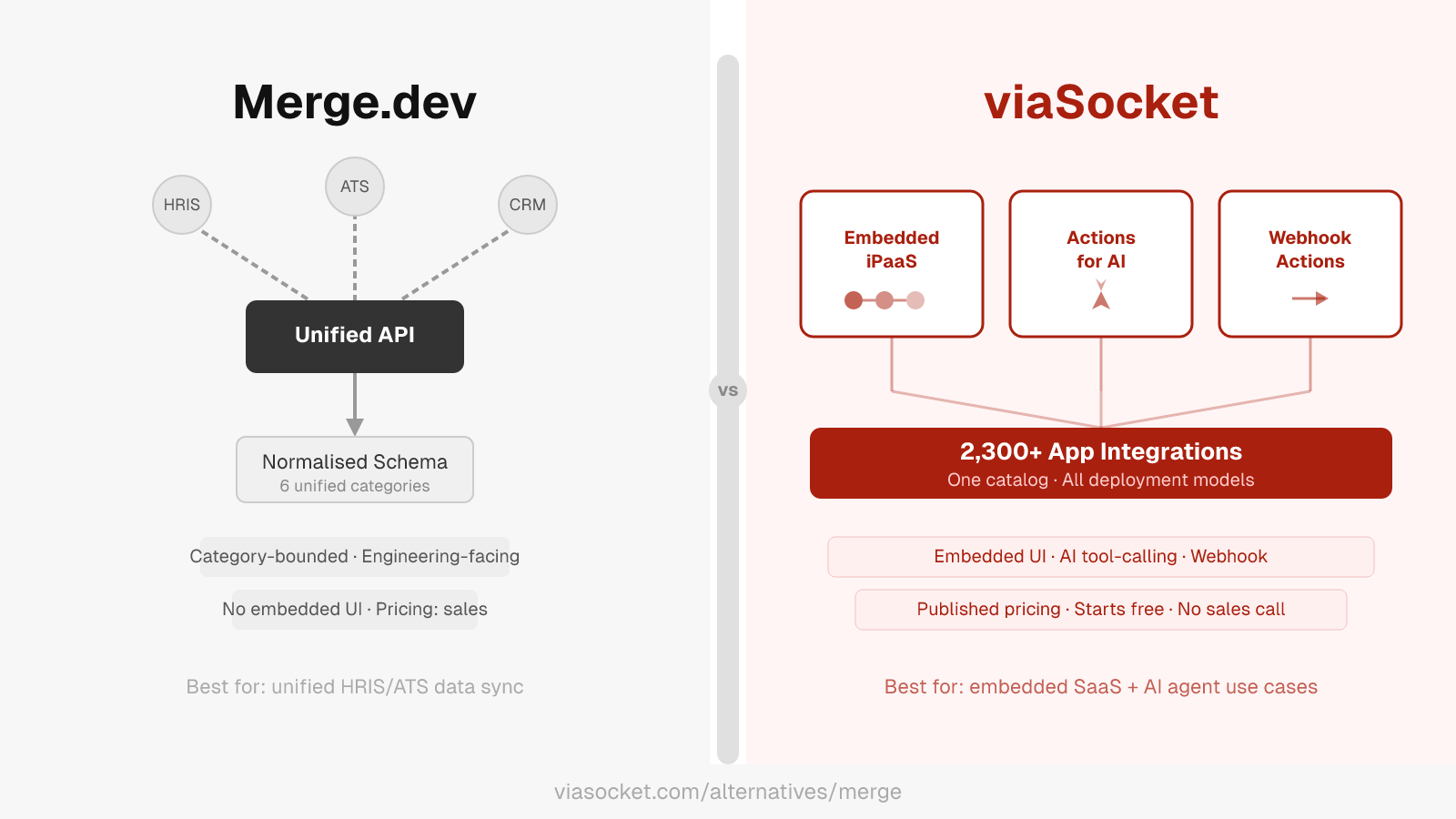
How this Paragon alternative compares with Merge.dev is covered in the alternatives guide.
Where Teams Look for Alternatives
Teams typically look for Paragon alternatives when:
1. Integration breadth. Paragon's connector catalog covers common B2B SaaS categories well. Teams whose users connect to less common or long-tail apps sometimes find gaps that require custom connector development.
2. AI agent delivery model. Paragon's ActionKit provides MCP-based integration for AI agents. Teams that need multi-modal AI delivery — tool-calling endpoint, user-facing white-label MCP server, and webhook-triggered action sequences — from a single integration catalog sometimes need a broader deployment surface.
3. Pricing structure. Paragon offers a free self-serve start, with paid tiers that require sales engagement for exact rates. Teams that want fully published, self-serve pricing at production scale look for alternatives.
4. Deployment flexibility. Some teams need the embedded workflow builder, AI tool-calling, and webhook-triggered automation to share the same integration catalog — without maintaining separate infrastructure for each pattern.
Five-Criteria Comparison: viaSocket vs Paragon
1. Deployment Model
Paragon offers an embedded integration UI (white-labeled, inside your SaaS product), managed OAuth per user, and ActionKit for AI agent MCP integration. Self-hosting is available for teams with data residency requirements.
viaSocket offers three deployment models:
- Embedded iPaaS — white-labeled visual workflow builder embedded in your SaaS, backed by 2,300+ app connectors
- Actions for AI — AI agent tool-calling across 2,300+ apps with per-user managed OAuth
- Actions via Webhook — backend webhook triggers multi-app action sequences
Both platforms cover the core embedded integration UI use case. viaSocket additionally covers the webhook-triggered action model without a UI layer.
2. Pricing Transparency
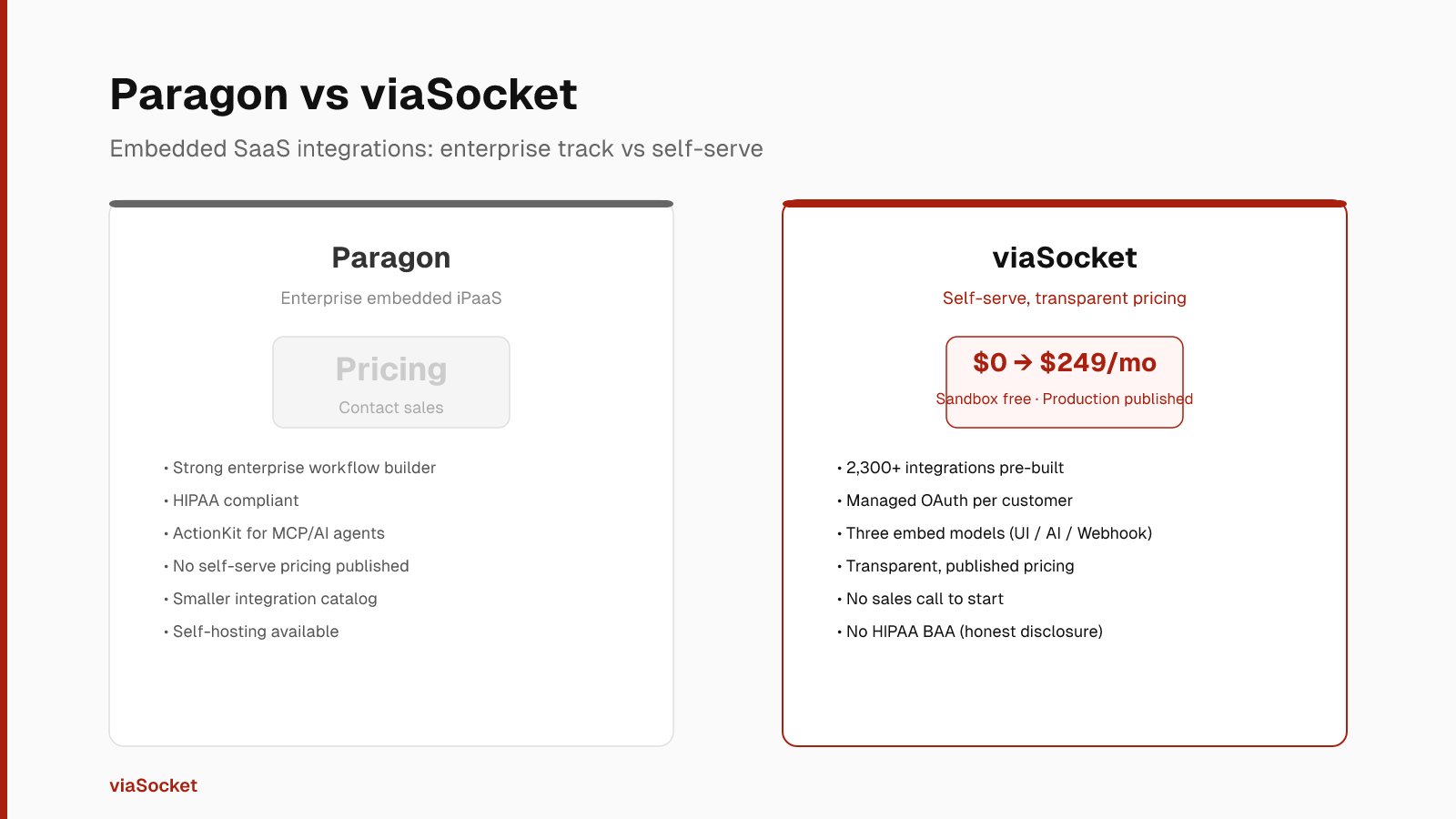
Paragon offers a free self-serve signup to start. Paid production rates are usage-based and require sales engagement for exact pricing. This is common for enterprise-grade embedded iPaaS platforms, but creates friction for teams that want to model costs before a sales call.
viaSocket Embed pricing is fully published:
- Sandbox: $0/month — 25 active users, 25K tasks/month
- Production: $249/month — 1,000 active users, 1M tasks/month
- Enterprise: custom
- Overages: $1/user, $1/2,500 tasks
No sales call required. Full details at /pricing.
3. Integration Breadth
Paragon covers a curated connector catalog across common B2B SaaS categories. The catalog is strong for CRM, HRIS, support, and productivity tools. Exact connector counts are not prominently published — check useparagon.com for the current catalog.
viaSocket provides 2,300+ pre-built app integrations maintained by the platform — CRM, marketing, support, finance, HR, developer tools, communication, and more. See /features for the full catalog.
For teams whose customers use a predictable set of enterprise tools, Paragon's curated approach may be sufficient. For teams needing broader coverage across less common apps, viaSocket's catalog breadth is an advantage.
4. AI/MCP Readiness
Paragon offers ActionKit — a server-side tool-calling layer that exposes your Paragon-managed integrations to AI agents. ActionKit lets your AI agent call Paragon-managed integrations as tool calls within your existing embedded integration setup. Paragon is investing actively in this area and ActionKit is a first-class product feature.
viaSocket provides AI integration through three delivery patterns:
- Actions for AI — 2,300+ app actions available as tool calls for your AI agent, with per-user OAuth scoped to your SaaS tenant model
- White-label MCP endpoint — a user-facing MCP server your customers can connect their own AI clients (Claude, Cursor) to directly
- Actions via Webhook — backend webhook model for multi-app action sequences
The architectural difference: Paragon's ActionKit exposes your existing Paragon-configured integration workflows to AI agents as tool calls. viaSocket's Actions for AI gives agents direct access to 2,300+ app actions without requiring a pre-configured workflow per integration. For teams that want AI agents calling controlled, pre-configured integration logic, Paragon's approach gives tighter control over execution. For teams that want a wide, dynamic action surface directly, viaSocket's model is a better fit.
5. Compliance and Security
Paragon: ISO 27001 certified; HIPAA compliance available (confirm current status directly with Paragon); self-hosting available for data residency requirements.
viaSocket: SOC 2 Type II certified, ISO 27001:2022 certified, GDPR and CCPA compliant. viaSocket does not currently offer HIPAA compliance or a BAA. Teams building healthcare applications or handling PHI must factor this into their platform decision. viaSocket's infrastructure runs on Google Cloud Platform with AES-256 encryption at rest and TLS 1.2+ in transit. See /help/security-and-compliance for full details.
Summary Comparison
| Criterion | Paragon | viaSocket |
|---|---|---|
| Deployment model | Embedded UI + ActionKit (server-side tool-calling) | Embedded UI + AI tool-calling + Webhook |
| Pricing transparency | Free start; paid rates require sales | Fully published, starts free |
| Integration breadth | Curated B2B catalog | 2,300+ apps |
| AI/MCP readiness | ActionKit (server-side tool-calling over configured workflows) | Tool-calling endpoint + white-label MCP + webhook |
| Self-hosting | Available | Not currently offered |
| HIPAA compliance | Available | Not currently offered |
| ISO 27001 | Certified (confirm current) | Certified (ISO 27001:2022) |
| Embedded workflow builder | Yes | Yes (all Embed plans) |
Choose Paragon if: Your customers are enterprises with HIPAA or data residency requirements, you need self-hosting, or you want AI agent integration that operates over pre-configured, controlled integration workflows. Paragon's enterprise compliance posture is a genuine differentiator.
Choose viaSocket if: You want fully published self-serve pricing, a broader 2,300+ app catalog, or a multi-modal AI delivery model (tool-calling + user-facing MCP + webhook) from a single integration infrastructure. If HIPAA compliance is not a requirement, viaSocket's pricing transparency and integration breadth are meaningful advantages.
Getting Started with viaSocket
The Embed Sandbox is free: $0/month, 25 active users, 25K tasks — enough to prototype a complete embedded integration experience for your SaaS product.
- Embed — App Integration
- Embed — Actions for AI
- viaSocket Features
- Use Cases for SaaS Builders
- Pricing
FAQ
Is viaSocket HIPAA compliant?
No. viaSocket is SOC 2 Type II and ISO 27001:2022 certified, and GDPR/CCPA compliant, but does not currently offer HIPAA compliance or a BAA. Teams building healthcare applications or handling PHI should evaluate Paragon or other platforms with HIPAA coverage.
Does Paragon offer a free tier?
Yes — Paragon has a free self-serve signup. Paid production rates are usage-based and require sales engagement for exact pricing. viaSocket's Sandbox tier is also permanently free at $0/month.
How does Paragon's ActionKit differ from viaSocket's Actions for AI?
Paragon's ActionKit exposes your existing Paragon-configured integration workflows to AI agents as server-side tool calls — the agent calls workflows you've already set up in Paragon. viaSocket's Actions for AI gives agents direct access to 2,300+ app actions without requiring a pre-configured workflow per integration, giving agents a wider, more dynamic action surface.
Does Paragon support more integrations than viaSocket?
No — viaSocket's catalog of 2,300+ apps is broader. Paragon's strength is in curated, deeply configured connectors for common enterprise B2B tools. For long-tail or less common apps, viaSocket's breadth is typically wider.
Can I migrate from Paragon to viaSocket?
Yes, though migration requires implementation work — OAuth connections, workflow configurations, and user-facing UI integration. viaSocket's managed OAuth and Embed SDK cover the core patterns. There is no automated migration tool between the two platforms.